
Walstad vs Father Fish: Which Natural Aquarium Method Works Best Without CO₂ or Filters?
Natural aquariums sound too good to be true — no CO₂, no filters, no water changes? Yet, two legendary methods claim exactly that: the Walstad Method and the Father Fish Setup.
But what’s the difference?
Which one actually works in the long run?
And can you really combine them for a thriving, self-sustaining tank?
Let’s break it all down — no fluff, just the facts.
What Is the Walstad Method?
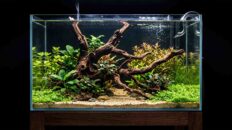
Developed by ecologist Diana Walstad, this method uses dirted substrate topped with gravel or sand. The idea is to create a natural, planted ecosystem where plants outcompete algae and waste is naturally recycled by microfauna.
✔ Minimal equipment
✔ Weekly light water changes
✔ Plants = natural filtration
🧪 According to research published in Springer’s Environmental Biology of Fishes, rooted aquatic plants significantly improve nitrogen uptake and reduce ammonia levels — key to Walstad’s success.
What Is the Father Fish Setup?
Popularized on YouTube by Father Fish, this method is more “deep ecology” than just dirt and gravel. It layers mineral-rich soil, clay, peat, and other additives beneath a deep sand cap — often 3 inches or more.
✔ No filters
✔ No water changes
✔ Zero maintenance (theoretically)
Unlike Walstad, Father Fish insists on no disturbance. The sand cap prevents gas exchange and creates an anaerobic zone that mimics natural lake beds.
Key Differences: Walstad vs Father Fish
| Element | Walstad | Father Fish |
|---|---|---|
| Substrate | Dirt + gravel/sand | Layered organic + deep sand |
| Maintenance | Weekly water change | No water changes |
| CO₂ use | Optional, usually none | Never |
| Filtration | Sometimes sponge | None |
| Plants | Essential | Recommended but optional |
| Disturbance | Some cleaning allowed | Zero interference |
Both rely on natural balance — but they differ in how that balance is created and maintained.
Which One Is Right for You?
🟩 Choose Walstad if:
You want plants to thrive without high-tech gear
You don’t mind light weekly maintenance
You prefer a science-backed, minimalist approach
🟧 Choose Father Fish if:
You want a truly hands-off system
You like experimenting with layered substrates
You’re okay with slower results and potential learning curves
Can You Combine the Two?
Yes… but carefully.
Some aquarists mix Walstad-style planting with Father Fish-style deep sand capping. However, combining philosophies can lead to gas pockets, nutrient overload, or oxygen crashes if not monitored.
🧠 Our tip? Master one before mixing both.
Scientific Backing: Does No-Filter Work?
Research shows that planted tanks with nutrient-rich substrates can maintain stable ammonia and nitrate levels for extended periods (source: Environmental Biology of Fishes – Springer). Still, every tank is different.
Even in natural setups, surface agitation and biodiversity (plants, snails, shrimp, microfauna) play crucial roles.
⏱️ Timestamps
0:00 – No CO₂, No Filter, No Water Changes? Two Methods Say Yes!
0:16 – Walstad vs Father Fish: Why It Matters for Natural Aquariums
0:36 – No Fluff. Just Facts. Pure Comparison
0:49 – Substrate Showdown: Walstad Dirt vs Father Fish Layers
1:26 – Water Movement: Gentle Flow or Still Like a Swamp?
1:58 – Water Change Debate: Light Maintenance vs Zero Intervention
2:28 – Which Natural Aquarium Method Is Right for YOU?
2:46 – Bonus Tip: Can You Combine Walstad and Father Fish?
3:02 – Comment Your Pick: Are You Team Walstad or Team Father Fish?
FishTank Mastery
FishTank Mastery is your go-to source for no-nonsense, science-backed aquarium tips. Whether you’re diving into the Walstad world or exploring the Father Fish frontier, we break it down so you can build smarter, healthier tanks — no tech headaches required.
Subscribe to our YouTube channel for fast, practical guides that make fishkeeping simple — and natural.
More Insights on Natural Aquarium Methods
Curious about tech-free setups? Learn the pros and cons of going natural in our No-Tech Aquarium FAQ. See real-life results in our No CO₂, No Filter, No Water Change Aquarium case study. For plant-friendly ideas, read Top 5 Easy Aquarium Plants for Nano Tanks. And to avoid common pitfalls, check our Top 5 Aquarium Myths That Still Fool Beginners.