
Overfeeding aquarium fish is the quietest way to wreck a tank that “looks fine.” The water can still look clear, the fish still swim up for food, and you still end up with cloudy water, ammonia spikes, algae, stressed fish, and that weird feeling that your aquarium is always one step away from chaos.
And here’s the annoying part: most beginners do it with love. You feed because they beg. You feed because you want them to grow. You feed because you feel guilty. Your fish learn that you are the food button, and they press it like a toddler in a candy aisle.
Let’s fix this properly. Not with “feed less” advice. With a system that keeps water stable, fish calm, and your tank boring in the best way possible.
The Most Common “Mystery” Tank Problems That Are Actually Overfeeding
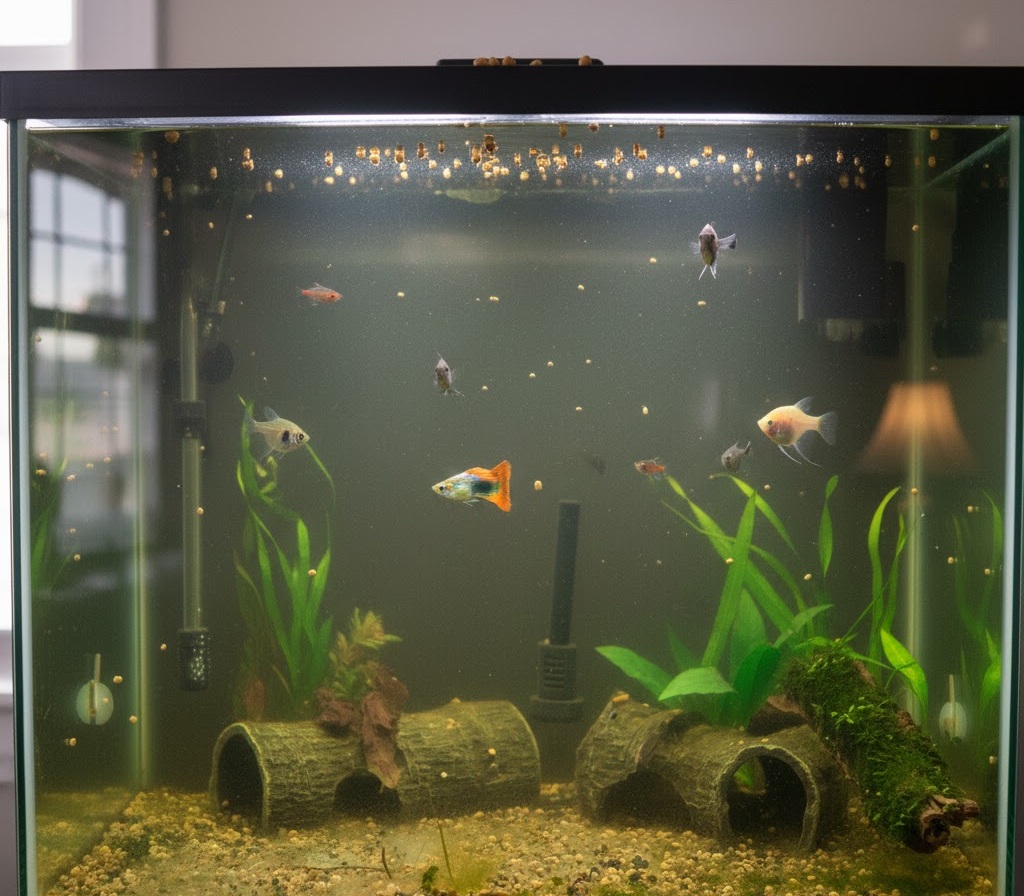
Overfeeding does not always show up as obvious leftover flakes on the gravel. In many tanks, the food disappears fast, and the problems show up later as pressure in the system.
- Cloudy water after feeding (bacterial bloom, fine particles, organics building up)
- Ammonia spikes or nitrite blips even though you “cycled” the tank
- Fish gasping near the surface in the morning (oxygen drops, bacteria party overnight)
- Algae growth that keeps returning no matter what you scrub
- Dirty filter that clogs too fast (your filter becomes a food processor)
- Fish stress, chasing, fin damage (unstable water and constant competition)
If any of that sounds familiar, you are not alone. You are not “bad at fishkeeping.” You are just feeding the tank like it is a puppy.
Why Fish Always Act Hungry (Even When They Are Not)
Fish begging at the glass is not proof of hunger. It is proof of learning.
In the wild, many species eat when food appears because food is not guaranteed. In a home aquarium, you are guaranteed. Your fish do not know your work schedule, but they know your footsteps, your lights, and the exact angle of your hand when you open the lid.
So yes, your fish will swim up excitedly. They will do it five minutes after you fed them. That does not mean their stomach is empty. It means they are professionals.
The Hidden Biology: Food Turns Into Waste Faster Than You Think
There are two main ways overfeeding hits your aquarium:
- Uneaten food breaks down and fuels bacteria, ammonia, and cloudy water.
- Eaten food becomes fish waste, which becomes ammonia, which becomes more work for your biofilter.
Either way, you are injecting extra nitrogen and organic load into a closed system. Your filter bacteria can handle a steady load. What they hate is the roller coaster: big feedings, messy spikes, and repeated “oops” days.
Fish Tank Overfeeding Symptoms Checklist
Use this quick checklist to spot the pattern. If you hit 3 or more, overfeeding is a serious suspect.
- Water looks slightly hazy or milky after feeding
- Filter floss turns brown very quickly
- Gravel has more mulm than expected between cleanings
- Algae returns fast after you remove it
- Fish poop is long and stringy most of the day
- Ammonia or nitrite shows up “randomly” on test kits
- Snails explode in population
- Bad smell when you open the lid, especially after lights out
How Much to Feed Aquarium Fish (A System, Not a Guess)
The classic advice is “feed what they can eat in 2 minutes.” That is not terrible, but it is incomplete because:
- Fast fish steal food from slow fish
- Food breaks apart, sinks, and disappears from view
- Some foods expand after soaking
- “Two minutes” becomes “two minutes plus a bonus round”
Instead, use a simple three-part system:
1) Start With a Baseline Portion
Pick a portion you can repeat consistently. Consistency beats perfection.
- Flakes: a small pinch, crushed between fingers so it spreads, not clumps
- Pellets: count them (yes, count them). Start low.
- Frozen: thaw first, feed tiny amounts, do not dump the cube juice in the tank
2) Feed In Two Micro-Rounds
Feed half. Wait 30 to 60 seconds. Feed the other half.
This reduces “food storms” and gives shy fish a chance. It also keeps fine particles from instantly coating everything like aquarium glitter.
3) Match Feeding Frequency to Tank Stability
If your tank is new, lightly stocked, or recently changed, feed less often.
| Tank Situation | Feeding Frequency | Goal |
|---|---|---|
| New tank (first 4 to 6 weeks) | Once daily, small portions | Keep ammonia stable |
| Stable mature tank | Once daily or split into two small feeds | Consistent bio-load |
| Cloudy water, algae, weird tests | Cut portions 30 to 50% for 7 days | Reduce organics fast |
| Heavy planted tank (healthy growth) | Normal feeding, still avoid excess | Plants help, but do not “delete” waste |
Notice what is missing: “Feed them until they are happy.” Fish are never happy. Fish are always hungry. That is their brand.
Cloudy Water From Overfeeding: What’s Actually Happening
When you see cloudy water after feeding, you are usually seeing one of these:
- Fine particles suspended in water (flakes breaking up, powdered food)
- Bacterial bloom feeding on extra organics
- Filter disturbance from increased waste and debris
A bloom can happen even in a cycled tank. Cycled means your bacteria handle ammonia. It does not mean the tank is immune to huge organic swings.
If you want a practical guide to clearing cloudy water, you can also check our related post here: cloudy aquarium water fix.
Fish Tank Ammonia Spike After Feeding: The “Invisible Leftovers” Problem
One of the sneakiest traps is when food vanishes quickly, but the tank still spikes ammonia. This often happens when:
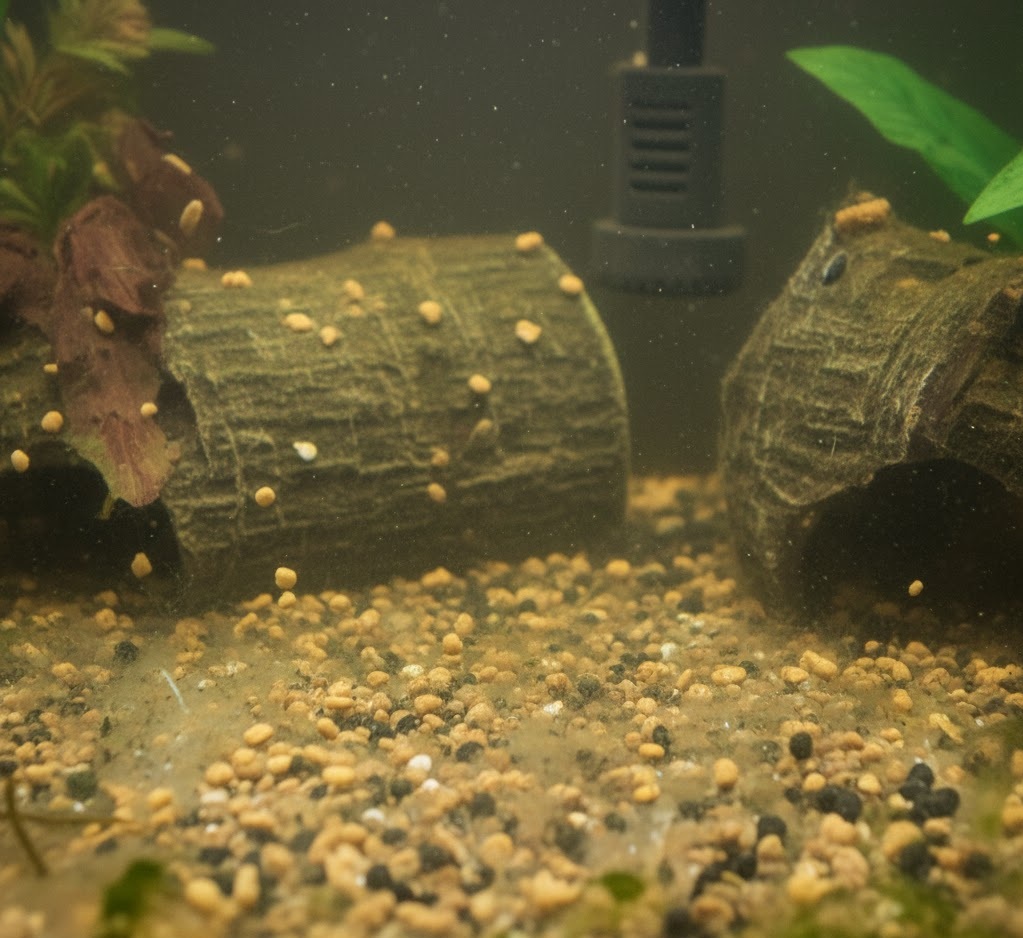
- Food is being pulled into the substrate or behind hardscape
- Fish are chewing and spitting fine particles
- Filter intake is shredding food and distributing it like confetti
- Bottom debris is building up, then releasing in bursts
Even if your fish “eat everything,” the waste load can still exceed what your biofilter comfortably processes, especially if the tank is stocked on the heavier side.
Fix It Fast: 7-Day Feeding Reset Plan
This is the quickest safe reset that improves water quality without drama.
Day 1 to 3: Cut Portions, Keep Routine
- Cut feeding by 30 to 50%
- Feed in micro-rounds
- Remove uneaten food after 2 to 3 minutes if it collects
Day 4 to 7: Add Structure, Not More Food
- Keep the reduced portion
- Use one “light day” (very small feed) if fish look fine
- Do not add new food types this week
Optional Support Moves (If Your Tank Is Already Messy)
- Rinse mechanical media (in tank water, not tap water)
- Vacuum visible debris lightly, do not deep-clean everything at once
- Increase surface agitation if fish gasp in the morning
The goal is stability. Not a total reset that shocks fish and bacteria at the same time.
What Most People Get Wrong About Feeding
1) They Feed the Glass, Not the Fish
Begging is not hunger. It is habit. If you reward begging, you train begging.
2) They Use Big Feedings as “Compensation”
Missed a day? Do not “make up for it.” Fish do not need a makeup meal. That logic is for humans and pizza.
3) They Ignore Food Type Density
Pellets can be extremely nutrient-dense. Frozen foods can pollute quickly if dumped without thawing. Flakes can explode into particles and mess up clarity.
4) They Forget That Growth Is Not Always the Goal
Many fish grow better in stable, clean, low-stress water with consistent feeding. More food does not always mean better growth. It often means worse water and a stressed immune system.
If you prefer seeing these concepts applied in real aquariums, our FishTank Mastery YouTube channel breaks down feeding mistakes, water stability issues, and real-world fixes using actual tanks. Many viewers find it easier to spot overfeeding patterns once they see how food, waste, and water quality interact visually.
Practical Feeding Tips That Keep Peace in Community Tanks
Overfeeding is also a social trigger. Food creates hierarchy battles.
- Spread food across the surface so one fish cannot guard a single feeding spot
- Use sinking foods strategically for bottom fish, but do not overdo it
- Turn off filter for 2 minutes during feeding if food is being sucked away (only if safe for your setup)
- Feed at consistent times so fish calm down between meals
Optional Video Embed (Only If You Want It Here)
If you want a visual walkthrough related to water clarity, you can embed this video in the post. If not, skip it. No forcing.
FAQ: Overfeeding Aquarium Fish
Can overfeeding kill fish?
Yes. Not because food is toxic, but because excess food and waste can destabilize water quality, reduce oxygen, and stress fish until they get sick.
How often should I feed aquarium fish?
Most community tanks do well with once daily feeding, or two very small feedings. The right answer depends on stocking, filtration, and how stable your water tests are.
Is it okay to skip feeding for a day?
For most healthy adult fish, yes. A light day can improve stability in tanks that run “dirty.” Do not do this for sensitive fry or special cases that require frequent feeding.
Why is my water cloudy after feeding even if fish eat everything?
Cloudiness can come from fine particles, organics dissolving, or bacteria responding to extra nutrients. Food disappearing does not mean it did not pollute.
What is the easiest way to stop overfeeding?
Use a repeatable portion, feed in two micro-rounds, and commit to a 7-day reset if your tank shows cloudy water, algae spikes, or unstable ammonia readings.
Closing: Make Your Tank Boring Again (That’s the Win)
The best aquariums are not the ones where you are constantly “fixing” something. The best aquariums are the ones that stay stable because the inputs are stable.
Overfeeding aquarium fish is not a moral failure. It is a system mistake. When you reduce the food pressure and make feeding consistent, the water calms down, fish stress drops, and suddenly your tank stops acting like it has a personality disorder.
If you want to take this one step further, choose one improvement this week: reduce portions, spread feedings, or run the 7-day reset plan. Any one of those moves can be the difference between a tank that struggles and a tank that runs itself.
Scientific Insight: Why Overfeeding Disrupts Aquarium Stability
Overfeeding aquarium fish does more than create visible waste. Scientific research shows that excess organic input rapidly alters microbial balance, oxygen availability, and nitrogen processing in closed aquatic systems.
According to research summarized by the Food and Agriculture Organization of the United Nations (FAO), uneaten feed and excess nutrients increase biological oxygen demand, which can reduce dissolved oxygen levels and stress aquatic organisms even when water appears visually acceptable.
Studies referenced by the United States Environmental Protection Agency (EPA) show that nutrient overload from organic waste directly contributes to ammonia formation and microbial blooms, a process that mirrors what happens in overfed home aquariums on a smaller scale.
Research published through university-based aquatic science programs, including work summarized by University of Missouri Extension – Fisheries & Aquaculture, explains that frequent overfeeding overwhelms biological filtration systems, leading to unstable nitrogen cycling even in established tanks.
In addition, freshwater ecology studies indexed by the U.S. Geological Survey (USGS) confirm that organic matter accumulation promotes bacterial respiration, which can lower oxygen levels overnight, a pattern commonly observed in aquariums with heavy feeding routines.
Together, these findings support what experienced aquarists observe in practice: feeding consistency and portion control are not optional details but core stability mechanisms in closed aquatic environments.