
If you’ve ever raised the temperature in your tank—for discus, for summer, or just to “help things along”—you’ve probably seen the same pattern play out.
At first, everything improves. Growth speeds up. Colors become more vibrant. Plants look healthier than ever, and it feels like you finally dialed the system in.
Then, a few weeks later, the same plants that looked perfect start to fall apart.
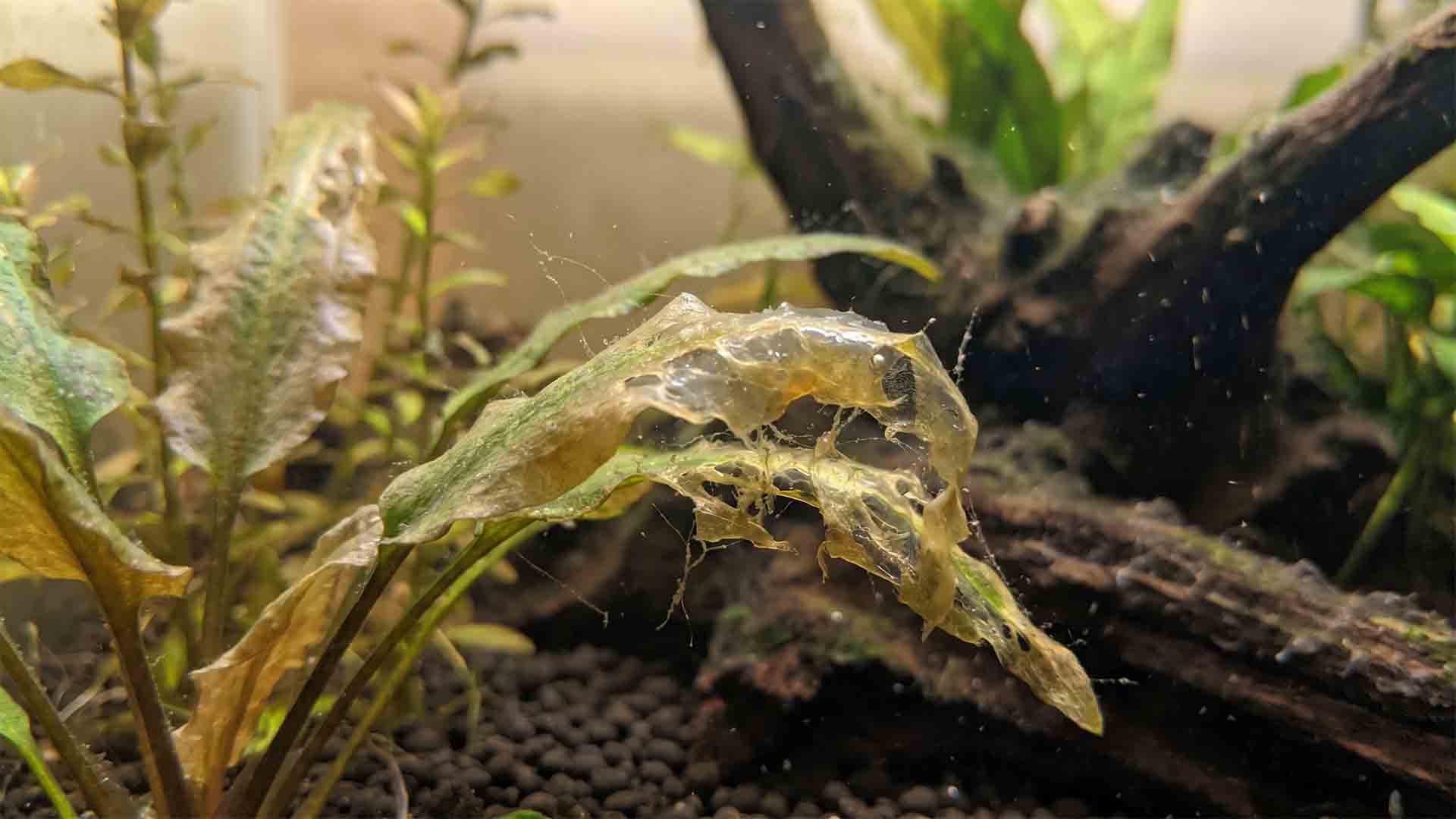
Leaves turn translucent. Stems weaken. Entire sections begin to dissolve, often faster than you can react. And the most frustrating part is that nothing obvious changed. Water looks clean, fish seem fine, parameters are “normal.”
This is the point where most hobbyists start chasing the wrong problem.
They blame the temperature. They blame the plant species. Sometimes they blame themselves.
But in reality, the issue is none of those things—at least not directly.
Most warm water planted tanks don’t fail because the plants can’t handle the heat. They fail because the system was never designed for how plants behave at higher temperatures.
Quick Answer: What Plants Actually Work in Warm Water Tanks?
The best aquarium plants for warm water tanks are not necessarily the “toughest” plants. They are the ones that can operate in what is effectively a low-resource system.
In practice, that usually means plants that either:
- have low metabolic demand and grow slowly,
- rely heavily on the substrate rather than the water column, or
- can tolerate fluctuations without immediately collapsing.
This is why species like Anubias, Java Fern, Amazon Sword, Cryptocoryne, and Vallisneria show up again and again in successful warm water setups. Not because they are indestructible, but because they are less dependent on the parts of the system that become unstable when temperatures rise.
But simply choosing the right plants is not enough.
If you don’t understand why plants fail in warm water, you will keep repeating the same pattern—no matter what species you choose.
Watch This Before You Choose Plants
If your tank currently “looks fine” but you’ve already noticed small warning signs—slower growth, pale leaves, or the first signs of melt—this breakdown will make a lot more sense once you see the system behind it.
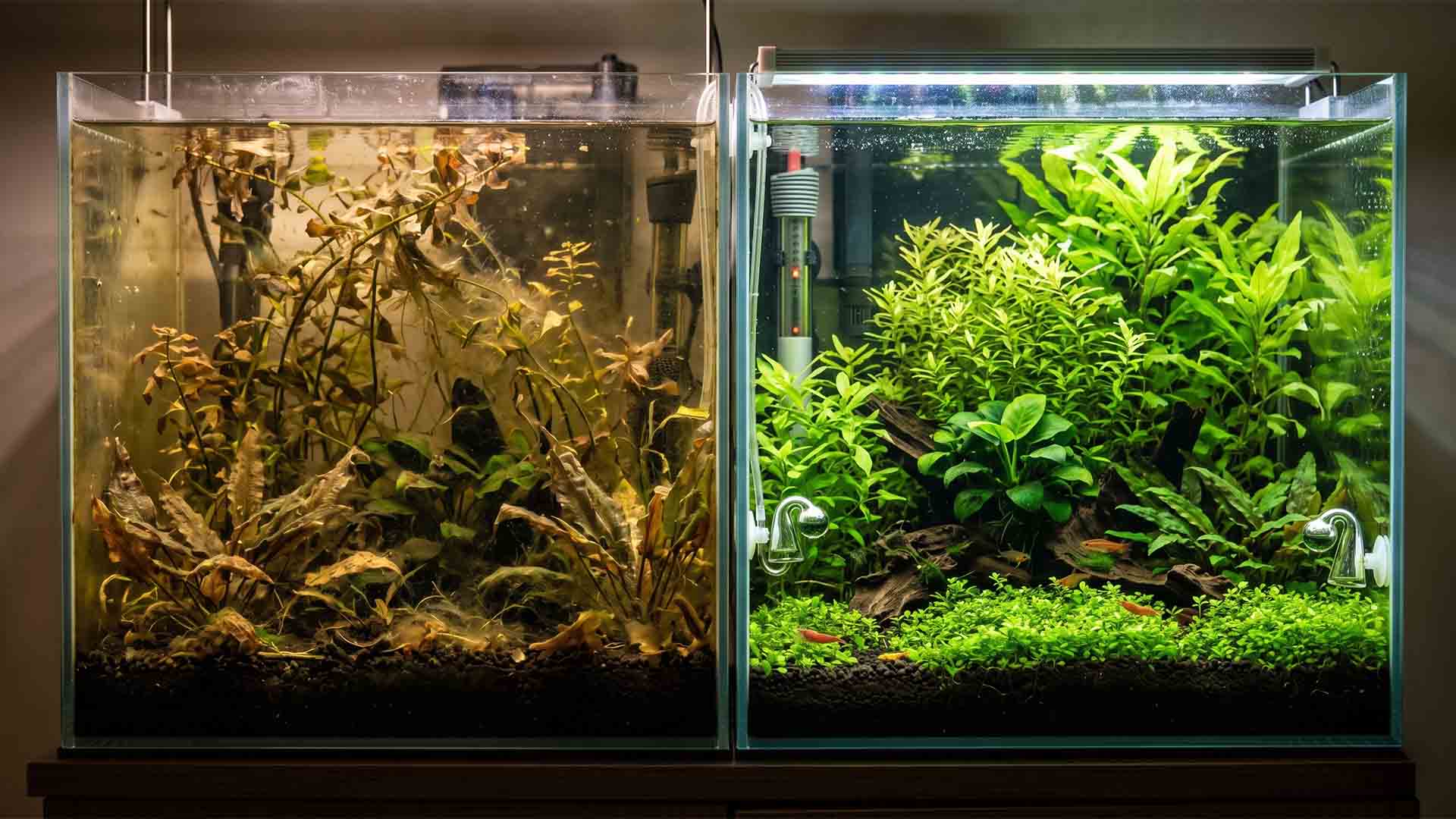
Why Aquarium Plants Melt in Warm Water Tanks(The Real Cause)
The most common explanation you’ll hear is simple: “It’s too hot for the plants.”
That explanation is easy—but it’s incomplete.
Temperature, by itself, is rarely the direct cause of plant death in aquariums. In fact, many tropical aquatic plants can tolerate temperatures in the 28–30°C (82–86°F) range without immediate damage.
The real issue is what temperature does to the environment around those plants.
As water temperature increases, several things happen at the same time:
- The amount of dissolved oxygen the water can hold decreases.
- The availability of dissolved CO2 becomes more limited.
- Biological processes, including plant metabolism, speed up.
Individually, none of these changes seem catastrophic. Together, they create a system that behaves very differently from what most hobbyists expect.
Plants are suddenly trying to grow faster while the resources they depend on—especially dissolved gases—are becoming harder to access.
This mismatch is subtle at first, but it compounds over time.
The “Hunger Gap”: Why Plants Fail Later, Not Immediately
To understand why warm water tanks often look stable before they fail, you need to look at the system through a slightly different lens.
We call this the Hunger Gap.
It’s not a scientific term you’ll find in textbooks, but it accurately describes what happens inside many planted aquariums under thermal stress.
As temperature rises, plant metabolism accelerates. This is consistent with what is often referred to as the Q10 temperature effect, where biological activity increases with temperature.
At the same time, the physical ability of water to hold gases decreases—a relationship described by Henry’s Law.
In simple terms:
- Your plants are demanding more carbon and oxygen.
- Your water is providing less of both.
That gap between demand and supply doesn’t cause immediate failure. Instead, it creates a slow drain on the system.
Plants initially compensate. They use stored nutrients. They push faster growth. They even look healthier for a short period.
But that phase is not stability.
It’s acceleration toward depletion.
Once the system crosses a certain threshold, plants can no longer sustain that demand. And when that happens, they don’t gradually decline.
They collapse.
Why Everything Looks Fine… Until It Doesn’t
This delayed failure is what confuses most hobbyists.
Because early in the process, warm water tanks can actually appear more successful than cooler ones.
Plants grow faster. Colors can intensify. New leaves appear quickly. On the surface, everything suggests that the system is thriving.
But underneath, the balance is already shifting.
Resources are being consumed faster than they are replenished. CO2 becomes limiting. Oxygen levels fluctuate. Nutrient uptake becomes inconsistent.
None of these changes are dramatic enough to trigger an immediate reaction.
So the system continues… until it can’t.
By the time visible melting begins, the underlying problem has usually been building for days or even weeks.
That’s why reactive fixes—adding fertilizer, increasing CO2 suddenly, or changing plants—often make things worse instead of better.
You’re trying to correct a system that has already moved past its stable state.
Why Fast-Growing Plants Fail First in Warm Tanks
One of the most counterintuitive patterns in planted aquariums is this:
The plants that grow the fastest are often the first to die.
This becomes even more pronounced in warm water systems.
Fast-growing stem plants—like Water Wisteria, Ludwigia, or Hygrophila—require a continuous supply of CO2, nutrients, and stable conditions to sustain their growth rate.
When temperature increases, their growth accelerates, but so does their consumption.
If the system cannot keep up, these plants are the first to experience deficiency at a structural level.
That’s why they often show dramatic symptoms:
- rapid leaf loss,
- transparency,
- sudden collapse of entire stems.
In contrast, slower-growing plants with lower metabolic demand are not pushing the system as hard. They operate within a narrower resource envelope, which makes them more resilient when conditions become suboptimal.
| Plant Type | Resource Demand | Behavior in Warm Water |
|---|---|---|
| Fast-growing stem plants | Very high | Rapid growth followed by sudden collapse |
| Moderate growers | Medium | Gradual stress under instability |
| Slow, low-demand plants | Low | Stable, long-term survival |
This is not about which plants are “stronger.”
It’s about which plants are better matched to the system you’ve created.
The Critical Divide: Root Feeders vs Water Column Plants
Another pattern becomes clear once you look at how different plants source their nutrients.
Not all plants depend on the same part of the aquarium.
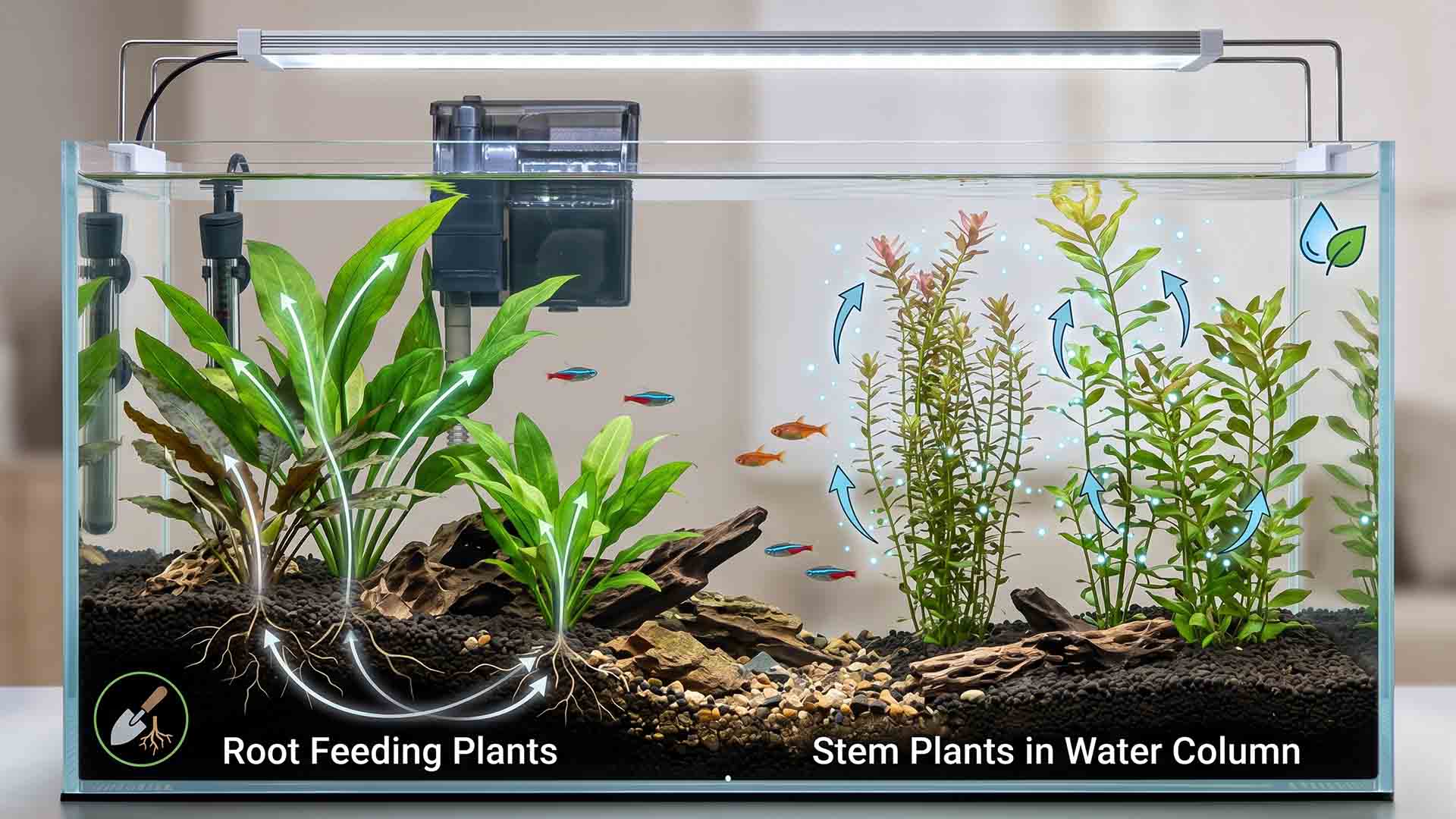
Some rely heavily on the water column—absorbing dissolved nutrients and CO2 directly from the water.
Others rely primarily on the substrate, drawing nutrients through their root systems.
This distinction becomes critical in warm water tanks.
| Feeding Type | Primary Dependency | Stability in Warm Water |
|---|---|---|
| Water column feeders | CO2 and dissolved nutrients | Unstable |
| Root feeders | Substrate nutrients | More stable |
Warm water disproportionately affects the water column—especially gas availability.
The substrate, on the other hand, changes more slowly and often retains nutrients more consistently.
This is why plants like Amazon Sword and Cryptocoryne tend to outperform many stem plants in warm setups.
They are not immune to failure, but they are less exposed to the most unstable part of the system.
Scientific Context (What the System Is Actually Doing)
The behavior you’re seeing in warm water tanks is not random.
It follows well-understood physical and biological principles.
As temperature increases, the solubility of gases in water decreases—a relationship described by Henry’s Law. This means that at higher temperatures, your tank physically holds less dissolved oxygen and less CO2.
At the same time, biological processes—including plant metabolism—accelerate with temperature. This is commonly described using the Q10 temperature coefficient, where reaction rates increase as temperature rises.
Together, these two effects create a system where demand increases while supply decreases.
In controlled environments with injected CO2 and tightly managed parameters, this can be compensated for.
In typical hobbyist tanks, especially low-tech or discus setups, it usually cannot.
That is why warm water systems often appear stable… until they aren’t.
Scientific References
- USGS – Dissolved Oxygen and Water Temperature
- EPA – Dissolved Oxygen in Aquatic Systems
- Henry’s Law and Gas Solubility
These principles are consistent with established water chemistry and aquatic system research, especially around dissolved oxygen, gas solubility, and thermal stress in aquatic environments.
If you want to see how these scientific principles show up in real aquarium mistakes, this guide is the natural next step. It connects system imbalance, plant decline, and avoidable setup errors in a way that applies directly to planted tanks running under pressure: STOP Doing THIS If You Want Thriving Aquarium Plants.
And if your warm tank is not just melting plants but also pushing fish into stress, the problem may be broader than plant biology alone. This article helps explain why apparently “normal” tanks still fail when the underlying system is already unstable: Why Water Tests Are Lying To You.
In practical terms, this means that most plant failures in warm aquariums are not random events, but predictable outcomes of how temperature reshapes gas availability and metabolic demand inside the system.
Where Most People Go Wrong
At this point, most hobbyists make a predictable mistake.
They try to solve the problem by changing the plant list.
They search for “heat-tolerant plants” or “plants for discus tanks” and replace one species with another.
Sometimes that works temporarily.
But if the underlying system remains the same, the outcome doesn’t change.
Most planted tanks fail not because of the plants you choose, but because of the system those plants are placed into.
Once you understand that, you stop chasing lists… and start building systems.
10 Aquarium Plants That Actually Survive Warm Water (And Why)
By this point, the pattern should be clear.
Plants don’t fail in warm water because they are “too sensitive.”
They fail because they are built for a system that no longer exists.
The plants below don’t survive heat by luck. They survive because they are aligned with how warm water systems actually behave.
Some rely less on dissolved gases. Some pull nutrients from more stable sources. Others simply avoid pushing the system too hard.
Understanding that difference is more important than memorizing any list.
#10 – Water Wisteria
Water Wisteria is often one of the first plants people try in a new setup, especially because of how quickly it grows. In a stable environment, that speed is an advantage. In a warm tank, it can become a problem.
As temperature increases, its growth rate accelerates, which also increases its demand for CO2 and nutrients. When the system cannot keep up, the plant doesn’t gradually slow down—it begins to break down structurally.
This is why it often looks great at first, then suddenly collapses.
If you notice transparency in the leaves or rapid thinning, it’s usually not a species problem. It’s a signal that the system is already under pressure.
#9 – Dwarf Sagittaria
Dwarf Sagittaria doesn’t stand out visually, but it plays a very different role in a warm water tank. Unlike many stem plants, it relies heavily on the substrate.
This gives it a significant advantage in environments where the water column becomes unstable. While dissolved gases fluctuate, the substrate remains relatively consistent, allowing the plant to continue functioning even when other species struggle.
When Dwarf Sag begins to stall—especially in its runners—it’s often an indication that the substrate itself is depleted or compacted.
#8 – Ludwigia Repens
Ludwigia sits in an interesting position. It is not inherently fragile, but it is highly responsive to change.
In a balanced system, it can tolerate warm temperatures without major issues. However, it depends more heavily on the water column than root-based plants. This makes it sensitive to fluctuations in CO2 and nutrient availability.
What makes Ludwigia valuable is not just its appearance, but its behavior. It often reacts before other plants do.
If it begins dropping leaves or showing instability, the system is already drifting—even if everything else still looks fine.
#7 – Hygrophila
Hygrophila is often described as an “easy” plant, but in warm water systems, it behaves more like a diagnostic tool.
Its rapid growth rate means it responds quickly to changes in resource availability. When conditions are good, it thrives. When they aren’t, it shows stress almost immediately.
This makes it useful in one specific way: it tells you when something is wrong before more stable plants are affected.
Pale growth, distorted leaves, or slowed expansion are early indicators that your system is no longer keeping up with demand.
#6 – Bacopa
Bacopa survives where many plants fail because it is less specialized in how it feeds.
It can draw nutrients from both the substrate and the water column, which gives it a degree of flexibility when one source becomes unreliable.
In warm water, this dual strategy acts as a buffer. When CO2 becomes limited or nutrients fluctuate, Bacopa doesn’t collapse immediately. Instead, it shifts into a slower, stretched growth pattern.
That stretched appearance is not a sign of healthy growth—it’s a sign that the plant is conserving energy.
Practical note: Bacopa performs better in warm tanks when it is used as a buffer species rather than a showcase stem plant. Give it stable light, avoid aggressive pruning during stressful periods, and watch its structure closely. If it starts stretching or thinning, treat that as a warning from the system, not just from the plant.
#5 – Vallisneria
Vallisneria behaves differently from most plants in this list because of how it spreads. Instead of relying on rapid vertical growth, it expands horizontally through runners.
This allows it to tap into the substrate over a wider area, effectively distributing its nutrient demand.
In warm water systems, this can make it surprisingly resilient. It is not immune to instability, but it is less dependent on the most volatile parts of the environment.
However, when Vallisneria fails, it tends to fail quickly and on a large scale. A sudden collapse often points to a broader issue affecting the entire system.
#4 – Java Fern
Java Fern survives in warm water for a simple reason: it doesn’t demand much from the system.
It grows slowly, uses minimal resources, and does not rely on being planted in the substrate. Instead, it attaches to hardscape and absorbs what it needs directly from the water.
Because its metabolic demand is low, it is less affected by the drop in CO2 and oxygen that occurs at higher temperatures.
Most problems with Java Fern are not related to temperature, but to placement—especially burying the rhizome, which can cause it to rot regardless of conditions.
Practical note: In warm tanks, Java Fern is most useful when you place it in lower-stress zones with moderate flow and stable shade. It is not a plant you “push” for performance. It is a plant you use to keep the system visually planted while the more demanding species are being tested.
#3 – Anubias
Anubias follows a similar pattern to Java Fern, but with an even stronger bias toward stability over growth.
It does not try to keep up with increased metabolic demand. Instead, it maintains a slow, consistent pace that allows it to operate within limited resource availability.
This is why it often appears unchanged in warm tanks, even when faster plants are failing around it.
The main risk with Anubias is not temperature, but imbalance elsewhere in the system—particularly excess light, which can lead to algae growth on its leaves.
Practical note: Anubias works best when treated as a stability plant, not a growth plant. Attach it to wood or stone instead of burying it, keep it out of the highest-light zone in the tank, and use it to anchor the layout visually while faster plants do the changing around it.
#2 – Cryptocoryne
Cryptocoryne introduces a concept that is often misunderstood: not all plant “melting” is failure.
When conditions change—especially temperature, substrate composition, or water chemistry—Crypts may shed their leaves entirely.
To most hobbyists, this looks like the plant dying.
In reality, it is an adaptive response. The plant is resetting its structure to better match the new environment.
Because Crypts rely heavily on the substrate, they are less affected by short-term instability in the water column. Once they re-establish, they often become one of the most stable plants in a warm tank.
#1 – Amazon Sword
Amazon Sword consistently performs well in warm water systems, not because it is immune to stress, but because it operates almost entirely outside the most unstable part of the environment.
It draws the majority of its nutrients through its roots, which means it is less dependent on dissolved CO2 levels in the water column.
In a well-maintained substrate, this gives it a stable foundation even when the rest of the system is under pressure.
When Amazon Swords struggle, it is usually due to insufficient root nutrition rather than temperature itself. Yellowing older leaves are often the first sign.
Given the right conditions, however, this plant does more than survive—it dominates.
The Pattern Behind All of This
Once you step back from individual species, the pattern becomes difficult to ignore.
The plants that survive warm water conditions tend to share a few key traits:
- they have lower overall resource demand,
- they rely less on dissolved gases,
- and they draw nutrients from more stable sources.
In contrast, the plants that fail tend to depend heavily on the water column and push the system toward its limits.
| Surviving Plants | Failing Plants |
|---|---|
| Slow-growing, low demand | Fast-growing, high demand |
| Root-based feeding | Water column dependency |
| Stable, conservative growth | Aggressive, resource-intensive growth |
This isn’t about which plants are “better.”
It’s about which plants are compatible with the system you’ve created.
Why Discus Tanks Amplify the Problem
Discus tanks are a perfect example of how temperature can reshape an entire planted system.
At 29–30°C (84–86°F), the conditions that many tropical fish prefer are already pushing the limits of what most plants are adapted to handle.
At these temperatures:
- dissolved oxygen is lower,
- CO2 availability is reduced,
- and metabolic demand is significantly higher.
This doesn’t make planted discus tanks impossible—but it does make them far less forgiving.
Plants that might survive in a standard tropical setup can quickly fail when exposed to the same conditions under higher temperatures.
This is why many experienced hobbyists default to root-heavy, low-demand species in discus environments, even if more visually dynamic plants are available.
Where Most Plant Lists Go Wrong
If you compare this analysis to most “best plants for warm water” lists, you’ll notice a key difference.
Most lists focus on species.
Very few explain behavior.
They tell you what works, but not why it works—or more importantly, when it stops working.
Most planted tanks don’t fail because of the plant you chose. They fail because the system no longer supports the way that plant functions.
Once you understand that, you stop chasing plant lists… and start building systems that can actually sustain them.
How to Build a Warm Water Planted Tank That Actually Holds Up
By now, one thing should be clear.
Most plant problems in warm aquariums are not random events. They are predictable outcomes of how the system is built.
That means the solution isn’t reacting faster. It’s designing the tank in a way that avoids the problem entirely.
If you get the system right, most of the issues people struggle with simply don’t appear in the first place.
Start With the Right Baseline: Low-Demand First
In a warm tank, every decision you make should reduce pressure on the system, not increase it.
The easiest way to do that is by starting with plants that have naturally lower demand. These plants don’t push for rapid growth, which means they don’t rely as heavily on a constant supply of CO2 and dissolved nutrients.
That’s why setups built around species like Anubias, Java Fern, Cryptocoryne, and Amazon Sword tend to remain stable over time. They are not chasing growth—they are maintaining it.
Once that foundation is stable, you can experiment. But starting with high-demand plants in a warm system is one of the fastest ways to create instability.
Build Your Stability in the Substrate, Not the Water
One of the most overlooked aspects of warm water planted tanks is where stability actually comes from.
Most beginners focus on the water column—fertilizers, CO2, water changes—because that’s what’s easiest to adjust.
But in warm tanks, the water column is also the least stable part of the system.
The substrate, on the other hand, changes much more slowly. It holds nutrients, buffers fluctuations, and provides a consistent source of energy for root-feeding plants.
That’s why a well-built substrate can carry a warm tank even when the water column isn’t perfect.
Without it, even the “right” plants can struggle.
Control Growth Speed Instead of Maximizing It
This is where a lot of experienced hobbyists still make mistakes.
They see fast growth as a sign of success, so they push it further—more light, more nutrients, sometimes more CO2.
In a cooler, controlled system, that approach can work.
In a warm tank, it often backfires.
Because the faster your plants grow, the faster they consume resources. And in a system where supply is already limited, that only widens the gap.
Instead of asking how to make plants grow faster, a better question is how to keep them growing consistently.
Reducing light intensity slightly, avoiding aggressive dosing, and keeping changes gradual can dramatically improve stability.
In warm water systems, slower growth is not a limitation—it’s a strategy.
Stability Beats Perfection
Another common trap is trying to “optimize” every parameter.
Perfect numbers look good on paper, but warm water tanks are less tolerant of fluctuation than most setups.
What matters more is consistency.
Regular water changes, stable temperature, and predictable feeding patterns create an environment where plants can adapt instead of constantly reacting.
Even small, repeated swings in conditions can push a system that is already under pressure into failure.
Use Your Plants as Early Warning Signals
By the time fish show stress, the problem is usually advanced.
Plants, on the other hand, tend to respond earlier.
Not dramatically—but predictably.
| Observation | What It Usually Means |
|---|---|
| New growth becomes pale | Nutrient imbalance or CO2 limitation |
| Leaves become thinner or translucent | Resource depletion under high demand |
| Growth slows while conditions seem stable | System approaching its limit |
| Sudden melting | System has already crossed the threshold |
Learning to read these signals early is what separates stable tanks from constantly failing ones.
Discus Tank Blueprint (84–86°F Systems)
Discus tanks are where all of these dynamics become more obvious.
At 29–30°C, you are operating close to the upper range for many common aquarium plants. That doesn’t mean a planted discus tank is impossible—it just means there is less margin for error.
In these setups, the goal is not diversity. It’s reliability.
What Actually Works
Most successful planted discus tanks rely on a relatively small group of plants:
- Amazon Sword as the structural centerpiece
- Cryptocoryne for mid-ground stability
- Anubias and Java Fern attached to hardscape
- Occasionally Vallisneria for background coverage
These plants share a common trait: they are not heavily dependent on rapid, water-column-driven growth.
What Usually Fails (and Why)
High-demand stem plants often struggle in discus temperatures unless the system is specifically designed to support them.
This doesn’t mean they are impossible to keep. But without consistent CO2 injection, stable nutrient dosing, and tight control over lighting, they are far more likely to fail.
In most hobbyist setups, that level of control isn’t practical long-term.
So instead of forcing those plants into the system, it’s more effective to choose species that align with it.
The One Rule That Matters Most
If you’re building a planted discus tank, everything comes down to one decision:
Are you designing for speed, or for stability?
Trying to maximize growth in a high-temperature environment almost always leads to instability.
Designing for consistency, on the other hand, allows the system to remain balanced even under pressure.
If your goal is a planted discus tank that stays stable instead of looking good for a month, it also helps to understand where temperature itself begins to push the system too far. This guide gives you practical ways to reduce thermal pressure before it starts affecting plant performance: How to Cool Aquarium Water Without a Chiller.
And if you are still trying to diagnose whether the issue is heat, lighting, or a broader planted tank imbalance, this article gives you the bigger picture. It is especially useful when your plants seem “fine” at first but decline later for reasons that don’t show up in simple care lists: STOP Doing THIS If You Want Thriving Aquarium Plants.
People Also Ask
Why are my aquarium plants melting in warm water?
As water temperature increases, dissolved oxygen and CO2 levels decrease while plant metabolism speeds up. This creates a resource imbalance, where plants demand more but receive less, leading to structural breakdown and melting.
Why do aquarium plants melt in summer?
During summer, higher ambient temperatures raise tank temperature, which reduces gas solubility in water. At the same time, plants grow faster and consume more resources, causing a delayed system collapse.
What aquarium plants can survive 85°F (30°C) water?
Plants such as Anubias, Java Fern, Amazon Sword, Cryptocoryne, and Vallisneria are more likely to survive high temperatures because they rely less on dissolved CO2 and more on stable nutrient sources like the substrate.
Do aquarium plants need more CO2 in warm water?
Yes. Higher temperatures increase plant metabolic activity, which raises CO2 demand. However, warm water holds less CO2, making it harder for plants to meet their requirements.
Why do fast-growing aquarium plants die first?
Fast-growing plants consume nutrients and CO2 at a much higher rate. In warm water, where supply is already limited, these plants quickly exhaust available resources and collapse.
Are root feeder plants better for warm aquariums?
In most cases, yes. Root feeder plants rely on the substrate, which is more stable than the water column. This makes them more resilient when dissolved CO2 and nutrients fluctuate.
Why do aquarium plants melt after a water change?
Sudden parameter changes, especially temperature shifts or CO2 fluctuations, can stress plants. In warm tanks, where the system is already unstable, this can trigger rapid melting.
Can aquarium plants survive without CO2 in warm tanks?
Yes, but only low-demand plants can maintain stability without additional CO2. High-demand species typically fail unless the system is carefully controlled.
Why do aquarium plants melt and then grow back?
Some plants, especially Cryptocoryne, melt as an adaptation response. They shed old leaves and regrow new ones better suited to the current environment.
How do you stop aquarium plants from melting in warm water?
Focus on reducing system stress: choose low-demand plants, build a strong substrate, control lighting, and maintain stable water conditions. Preventing imbalance is more effective than reacting after melt begins.
FAQ
Do aquarium plants die directly from heat?
Not usually. Heat rarely kills aquarium plants in a direct, immediate way. What it does is change the environment around them by lowering dissolved oxygen and CO2 availability while increasing metabolic demand. In most warm tanks, plant melt is the final result of that imbalance rather than the temperature itself.
Why do plants look healthy before they melt?
Because the early phase of a warm tank can look deceptively productive. Growth may accelerate, colors may improve, and new leaves may appear faster than expected. But that burst of performance often happens while the system is burning through resources faster than it can replace them. By the time visible melting starts, the imbalance has usually been building for days or weeks.
Should lighting be reduced in warm tanks?
In many cases, yes. Higher light increases growth demand, which means plants need more carbon and nutrients to keep up. In a warm tank where gas availability is already reduced, excessive lighting can push plants into failure faster. Slightly reducing intensity or duration often improves long-term stability.
Is substrate important in warm planted tanks?
Yes. A nutrient-rich substrate is one of the biggest advantages you can give a warm planted tank, especially if you are using root feeders like Amazon Sword, Cryptocoryne, or Dwarf Sagittaria. The substrate changes more slowly than the water column, so it provides a more stable nutrient source when dissolved resources become limited.
Can I keep stem plants in a warm water tank?
Yes, but they are usually less forgiving. Fast-growing stem plants depend heavily on stable CO2 and nutrient availability, which makes them more vulnerable in warm systems. They can work in controlled setups, but they are rarely the best starting point for hobbyists who want long-term stability.
Why do plants melt after a water change in warm tanks?
Water changes can trigger melt when they create a sudden shift in temperature, dissolved gases, or nutrient availability. In a system already close to its limit, even a helpful maintenance step can become the tipping point if the change is too abrupt. This is especially common in tanks running high temperatures without injected CO2.
Can you run a planted discus tank without CO2 injection?
Yes, but you need to be selective. A planted discus tank without CO2 works best when built around low-demand, root-feeding species such as Amazon Sword, Cryptocoryne, Anubias, and Java Fern. The goal is not maximum growth, but long-term reliability under high-temperature conditions.
Why do Cryptocoryne plants melt and then grow back?
Cryptocoryne melt is often an adaptation response rather than a sign of permanent failure. When conditions change, the plant may shed older leaves and then regrow foliage better suited to the new environment. In warm tanks, this makes Crypts one of the more stable long-term choices, even if they look dramatic during transition.
What is the best beginner plant for a warm water aquarium?
Amazon Sword is one of the best beginner options because it is forgiving, root-fed, and far less dependent on a perfectly stable water column than many stem plants. Java Fern and Anubias are also strong beginner choices if they are placed correctly and not forced into high-growth conditions.
How do I stop aquarium plants from melting in warm water?
The most effective approach is to lower system stress before visible melt begins. Choose low-demand plants, build a strong substrate, avoid chasing rapid growth, reduce excessive lighting, and keep the water temperature and maintenance routine as stable as possible. Preventing the imbalance works better than trying to reverse it after collapse starts.
Watch Next
If your plants are already melting, the next mistake is usually trying to “fix” the symptoms one by one. That almost never works for long. This breakdown explains the habits that quietly destabilize planted tanks before visible melt even begins: STOP Doing THIS If You Want Thriving Aquarium Plants.
If the real issue is temperature itself, then stabilizing the tank becomes more urgent than changing the plant list. This guide walks through practical cooling strategies that help reduce system stress without forcing you into expensive equipment right away: How to Cool Aquarium Water Without a Chiller.
And if your plants are growing too fast before they collapse, lighting may be pushing the system harder than you realize. This article connects light intensity to plant demand and helps explain why “good growth” can still be the start of a failure pattern: Aquarium Lighting Explained (PAR & Spectrum).
Final Insight
Most people never actually solve this problem. They keep changing plants, adjusting fertilizers, or tweaking temperature, hoping the next small change will finally stabilize the tank.
But the pattern repeats because the issue was never the plant itself. It was the system those plants were placed into.
Warm water doesn’t just make your tank harder. It fundamentally changes how resources move, how plants grow, and how stability behaves over time. That’s why copying plant lists almost always fails in the long run.
The moment you stop asking “Which plant survives heat?” and start asking “Is my system built for how plants behave in warm water?” everything changes.
At that point, you’re no longer reacting to problems. You’re designing a system that prevents them. And once you build for that, plant melt stops being a mystery. It becomes predictable, and more importantly, avoidable.