
Cleaning aquarium filter causes ammonia spikes when you do it the “clean-looking” way, because your filter is a biological system, not a dirt collector. If you’ve ever searched “fish died after cleaning filter”, “ammonia spike after water change”, or “should I rinse filter media under tap water”, this guide explains the real reason tanks crash days later and what to do instead so your nitrogen cycle stays stable long term.
Watch First, Then Use This Checklist: STOP Cleaning Your Filter Like This
If you want the fastest results, watch the video first. Seeing the “dirty filter vs healthy biofilm” examples in real tanks makes the pattern click instantly. Then come back here and use the tables as your action map while you fix your setup.
Video: STOP Cleaning Your Filter Like This It Triggers Ammonia Spikes
Most aquarium crashes don’t happen immediately after cleaning. Fish often look fine for days, then ammonia spikes hit, stress builds, and fish start dying “for no reason.” That delay is exactly why this mistake keeps repeating, especially in beginner tanks that rely on one main filter for biological stability.
Why Cleaning Your Filter Triggers Delayed Ammonia Spikes
The biggest misunderstanding in fishkeeping is thinking the filter’s job is to look clean. Your filter’s most important job is housing beneficial bacteria and biofilm that process ammonia continuously. When you over-clean or rinse under tap water, you reduce bacterial capacity fast, and the system becomes fragile.
The dangerous part is the timing. Right after cleaning, fish can still look normal because the tank is coasting on leftover bacterial function and reduced waste load. Then feeding continues, waste rises, and the weakened biofilter can’t keep up. The ammonia spike shows up days later, so beginners rarely connect it to filter cleaning.
Why Fish Look Fine After Filter Cleaning (Then Suddenly Die)
Many people search “fish died days after cleaning filter” because the timing feels random. It isn’t.
Right after filter cleaning, ammonia does not always spike instantly. Fish may eat, swim, and behave normally for several days. That false calm is what makes this mistake so dangerous. During that window, beneficial bacteria populations are already reduced, but waste production has not yet exceeded the weakened biofilter.
Once feeding resumes and bacteria fail to keep up, ammonia rises quietly. By the time fish show stress, the damage has already started. Watching the timeline in the video makes this cause-and-effect obvious in a way text alone can’t.
Dirty Filter Media vs Healthy Biofilm (What “Clean” Really Means)
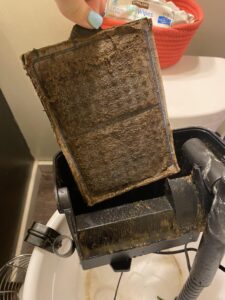
Search intent has shifted in recent years toward: “dirty filter good or bad aquarium?” The best answer is this: brown sponges, slime, and uneven coloration are often a sign your filter is biologically active.
That “dirt” is usually biofilm, a living bacterial layer processing ammonia every second. When you clean until the filter “looks new,” you are not improving efficiency. You are resetting biology.
If your filter still has decent flow and is not clogging, it usually does not need aggressive cleaning. A slightly “dirty” filter can be a healthier filter than a spotless one.
Fast Diagnosis Map: What Happened and What to Do Next
| What You Did | What You Saw | What Was Actually Happening | What To Do Now |
|---|---|---|---|
| Rinsed media under tap water | Tank looked cleaner | Chlorine/chloramine damaged bacteria | Stop tap rinsing, use dechlorinated tank water |
| Over-cleaned all media at once | Fish fine for 1-3 days | Biofilter capacity dropped silently | Test ammonia daily for a week, reduce feeding |
| Replaced “dirty” sponges/cartridges | Filter looked brand new | Most bacteria removed instantly | Seed new media with old, never replace all at once |
| Deep-cleaned after algae/cloudy water | Short-term clarity | Micro-crash cycle, repeat blooms | Fix root stability, not appearance |
How Often Should You Clean an Aquarium Filter?
This is one of the most searched questions, and one of the most misleading online.
There is no calendar-based answer.
Filters should be cleaned based on flow reduction, not appearance or routine. Cleaning too often keeps bacteria in constant recovery, making the system fragile. If your tank relies on a single filter, frequent cleaning is one of the fastest ways to recreate new tank syndrome.
If you want the “real-world” version of this rule, the video shows what a healthy “dirty” filter looks like and when cleaning is actually necessary.
Myths That Quietly Break Tanks After Filter Cleaning
Myth 1: “If the filter looks dirty, it needs to be cleaned”
A dirty-looking filter can be a healthy biological filter. If flow is fine, “dirt” is often beneficial biofilm, not a problem.
Myth 2: “Rinsing filter media under tap water is harmless”
Tap water is treated to kill microbes. Your filter runs on microbes. Even a short rinse can significantly reduce beneficial bacteria, depending on disinfectants used.
Myth 3: “If fish look fine after cleaning, the filter survived”
Delayed crashes are common because biological feedback is delayed. The system can look stable while pressure builds for days.
The 3 Truths About Filter Biology and Long-Term Stability
Truth #1: Your filter is a biofilter first, a dirt trap second
A filter’s most important job is maintaining bacterial capacity. A clean-looking filter that lost biofilm is less stable than a slightly dirty filter with strong biology.
Truth #2: “Capacity” matters more than “cleanliness”
You crash tanks when waste production exceeds bacterial capacity. Over-cleaning lowers capacity while feeding and bioload stay the same.
Truth #3: Stability beats perfection
The goal isn’t perfect-looking media. The goal is a stable nitrogen cycle that can handle normal feeding without spikes.
How to Clean Your Filter Without Triggering Ammonia Spikes
Step 1: Never clean all media at once
If you must clean, clean only part of the media and leave the rest intact so bacteria populations can recover without a full reset.
Step 2: Use dechlorinated tank water (not tap water)
Rinse media gently in a bucket of removed tank water during a water change. The goal is to clear heavy gunk while keeping biofilm alive.
Step 3: Clean for flow, not for looks
Stop when flow improves. Do not clean until everything looks spotless.
Step 4: Reduce feeding after cleaning
For 24 to 72 hours after any cleaning, feeding reduction lowers waste load while bacteria rebound. This is especially important if you cleaned too aggressively.
Step 5: Test ammonia and nitrite during the “danger window”
If you cleaned heavily, test ammonia daily for a week. Delayed spikes often show up later than beginners expect.
People Also Ask About Filter Cleaning and Ammonia Spikes
Why did I get an ammonia spike after cleaning my filter?
Because cleaning removed beneficial bacteria and biofilm, reducing biofilter capacity. The spike often appears days later as waste load exceeds the weakened bacteria population.
Can cleaning a filter crash the nitrogen cycle?
Yes. If you clean too aggressively, replace media, or rinse under tap water, you can remove enough bacteria to create a mini-cycle or full crash.
How do I know if my filter media has beneficial bacteria?
If the media is established and has been running in a stable tank, it contains biofilm. A brown or “dirty” look is often normal and healthy.
Should I replace filter cartridges?
Replacing cartridges can remove most bacteria at once. If you must replace media, seed new media with old and never replace all media in one go.
How long after cleaning can an ammonia spike happen?
Often within 24 to 72 hours, but it can take longer depending on feeding, stocking, and how much biofilm was removed.
FAQ: Filter Cleaning Without Killing Beneficial Bacteria
Is it my fault if fish died after filter cleaning?
Most beginners follow advice that equates “clean” with “healthy.” The failure is usually a knowledge gap, not neglect. Once you understand biofilm and delayed biology, you can prevent repeat crashes.
Does bottled bacteria fix ammonia spikes?
Sometimes it helps, but it rarely replaces a mature biofilm instantly. Stability comes from time, surface area, oxygen, and not stripping the filter repeatedly.
What is the best “first fix” if I can only do one thing today?
Stop tap rinsing immediately and stop cleaning for looks. Then reduce feeding and test ammonia. These three actions prevent most delayed crashes from getting worse.
Should I clean the filter during a water change?
If you need to clean for flow, a water change is the safest time because you can rinse media in removed tank water. Just avoid deep-cleaning everything at once.
How long does it take beneficial bacteria to recover?
Recovery depends on how much biofilm you removed. Minor gentle rinsing may recover quickly. Aggressive cleaning or replacement can take weeks to fully stabilize.
Hub and Spoke: Fix the Whole System
Over-cleaning filters rarely causes just one problem. It is usually the start of a chain reaction.
When beneficial bacteria are stripped away, ammonia spikes are often followed by algae blooms because stability drops and nutrients swing. If your tank keeps growing algae no matter what you clean, the guide Stop Doing This – Why Your Tank Gets Algae explains how overcleaning, rushed stocking, and chemical shortcuts keep algae returning even in “clean” tanks.
The same biological instability that triggers ammonia spikes can also keep your water cloudy even when you think you’ve “fixed” it. If your tank clears briefly and then turns cloudy again, Stop Doing THIS if Your Aquarium Water Stays Cloudy! breaks down why damaged biofilters create repeat haze cycles and how to stabilize clarity long term.
If you run planted tanks, filter crashes can also show up as plant melt or chronic stalling because stability and nutrient processing are connected. If your plants keep melting after maintenance, STOP Doing THIS If Your Aquarium Plants Keep Melting connects the biology of stability with plant health in a way most guides skip.
When these guides are used together, they form a fix chain: stable biofilter, stable water, stable nutrients, calmer fish behavior, and fewer recurring “mystery” problems.
Scientific References
Nitrification is an active biological process, not a switch you turn on with cleaning. Scientific overviews of nitrification explain that ammonia-oxidizing bacteria grow in response to waste load and require time, oxygen, and surface area. This directly supports why aggressive filter cleaning causes delayed ammonia spikes rather than instant visible crashes. Read the ScienceDirect overview
Clear water does not equal safe water. The U.S. Environmental Protection Agency documents that unionized ammonia becomes toxic at extremely low concentrations, and toxicity shifts with temperature and pH. This explains why fish can die in water that looks visually perfect after maintenance. Read EPA Aquatic Life Criteria
Biofilm structure matters. Research on microbial biofilms shows that bacteria living in structured communities behave differently and can be more resilient than free-floating bacteria. When biofilm is physically removed during deep cleaning or media replacement, systems lose stability and redundancy, which helps explain why bottled bacteria often fails to “instantly” replace what was lost. Read the biofilm overview
Watch Next (STOP Series)
If this filter mistake felt familiar, it is usually not the only one. Most crashes come from a chain of beginner habits, not one bad day.
The video STOP Doing These Aquarium Mistakes (Beginner Guide) connects filter crashes with other habits that quietly destabilize tanks over time, so you can stop repeating the same loop.
If algae keeps returning no matter how much you clean, STOP Doing THIS – It’s Causing All Your Algae Problems shows why “more cleaning” often creates worse algae long term by breaking stability.
For planted tanks that keep melting after maintenance, STOP Doing THIS If Your Aquarium Plants Keep Melting explains how stability and plant health connect, and why filter crashes can show up as plant problems.
If your tank keeps going cloudy after you “fix it,” STOP Doing THIS if Your Aquarium Water Stays Cloudy! breaks down repeat haze cycles and how to stabilize clarity without chasing quick fixes.
Final Reminder
Most beginners think cleaner equals healthier. In reality, a filter is a living biological engine. If you want the fastest diagnosis and the cleanest “do this instead” plan, watch the video at the top first, then work through the tables in this article in order.