
An aquarium chiller sounds optional right up until your tank hits summer heat and starts failing in slow motion.
That is the expensive mistake. Most hobbyists treat overheating like a temporary inconvenience. A fan goes on, the lid comes off, evaporation speeds up, and everyone hopes the tank “gets through it.” Sometimes it does. Sometimes it doesn’t. And when it doesn’t, the losses are rarely cheap.
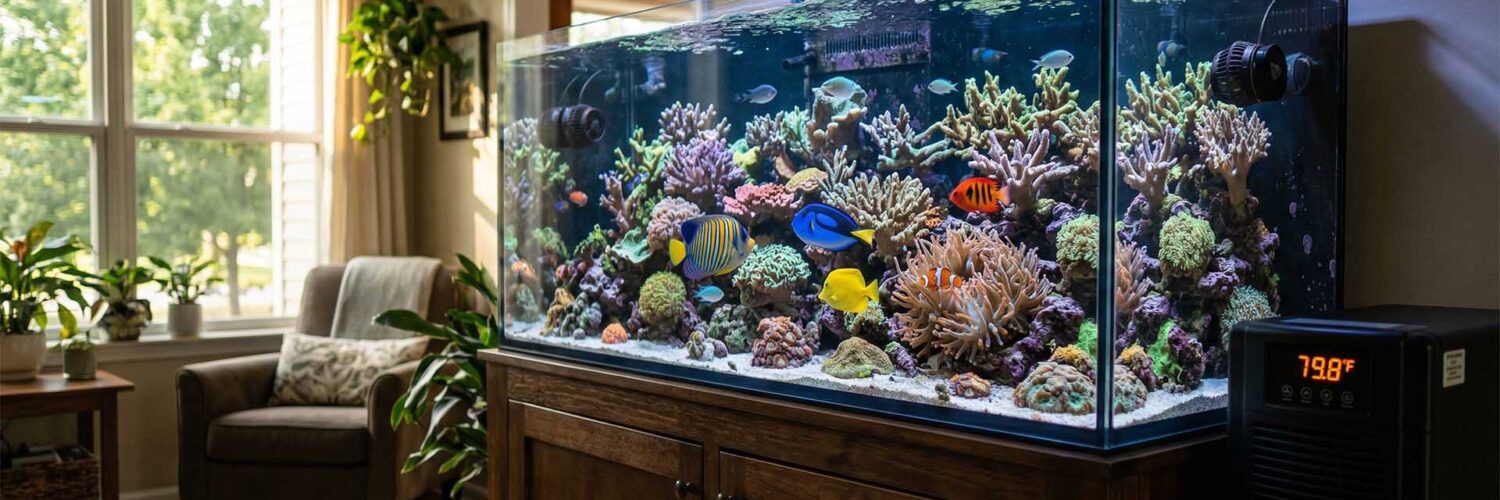
In high-end reef systems, expensive coral colonies, rare fish, and already-fragile oxygen balance can unravel faster than most people expect. This is why professional aquarium chillers are not luxury gear for many setups. They are insurance.
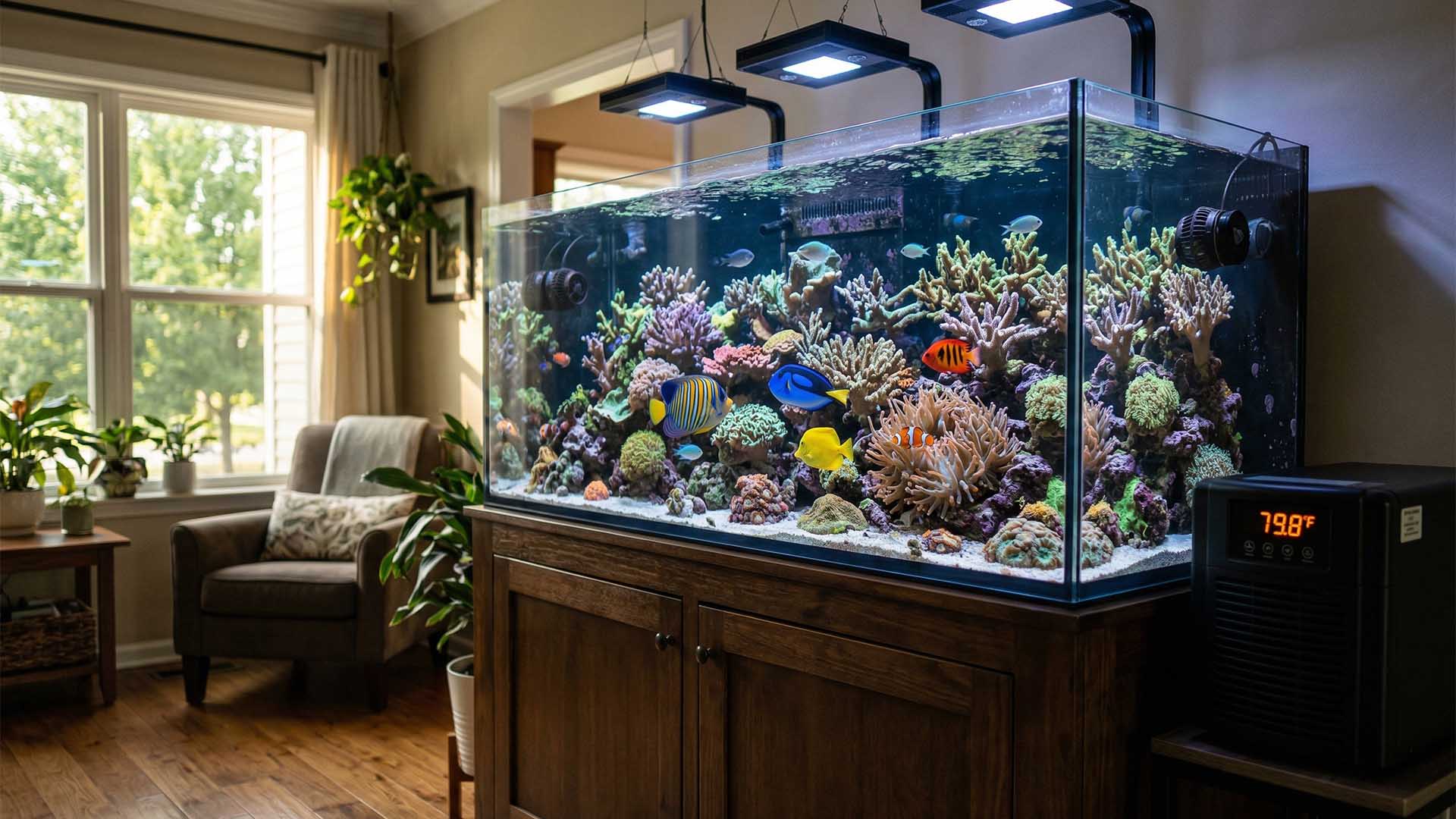
Why Aquariums Crash in Summer
Summer tank crashes rarely happen because the thermometer suddenly jumps into cartoon-danger territory. Most crashes happen because rising heat quietly changes everything else first.
- Warm water holds less oxygen.
- Fish metabolism increases.
- Bacterial activity accelerates.
- Corals and sensitive fish lose stability margin.
That means your tank can look visually normal while its safety buffer gets thinner every day.
Heat is not just a temperature problem. It is an oxygen, metabolism, and stability problem.
Signs Your Tank Is Overheating Before It Actually Crashes
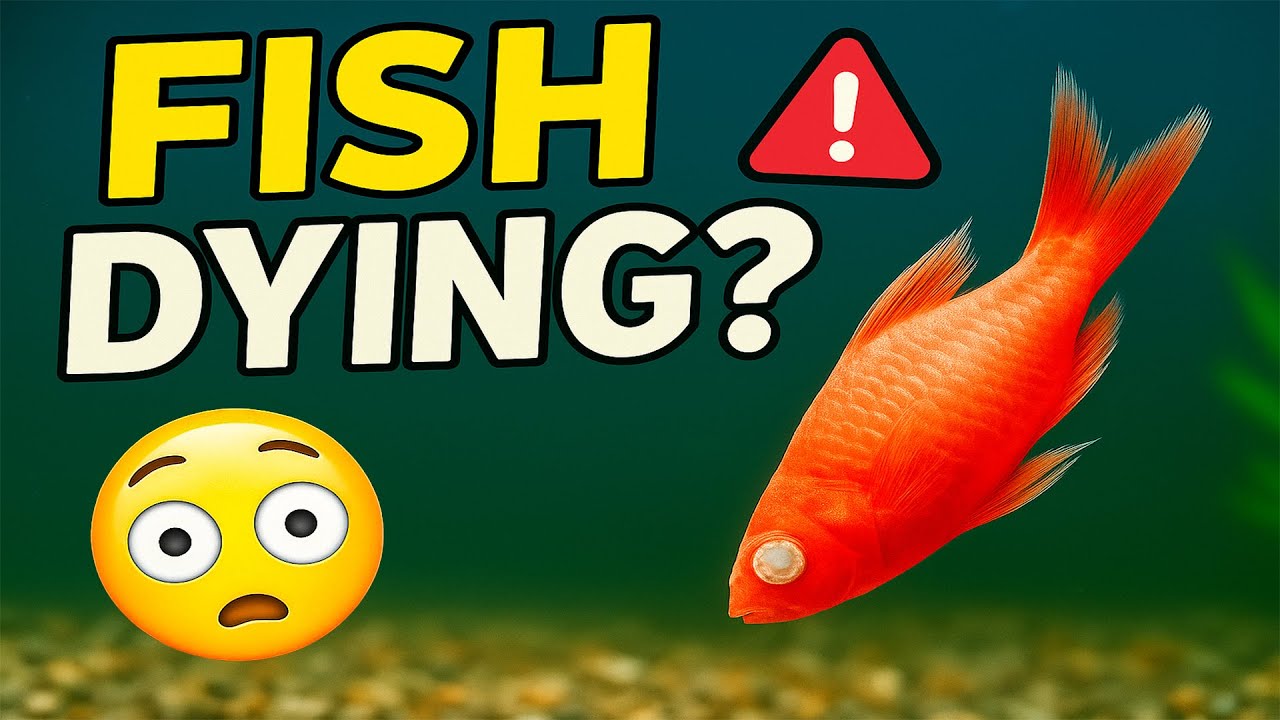
Most tanks give warning signs before the real damage starts. The problem is that many hobbyists treat these signs as minor stress instead of systemic heat risk.
- Fish hovering higher in the water column
- Faster breathing, especially in the evening
- Reduced feeding response
- Corals staying closed longer than usual
- Algae picking up speed during hot periods
- Evaporation suddenly increasing
If you see several of those at once, you are not dealing with “summer laziness.” You are watching your tank use up its stability reserve.
Heat also accelerates algae growth by increasing biological activity and nutrient cycling. If algae is getting worse during summer, this guide connects the dots:
Stop Doing This – Algae Problems.
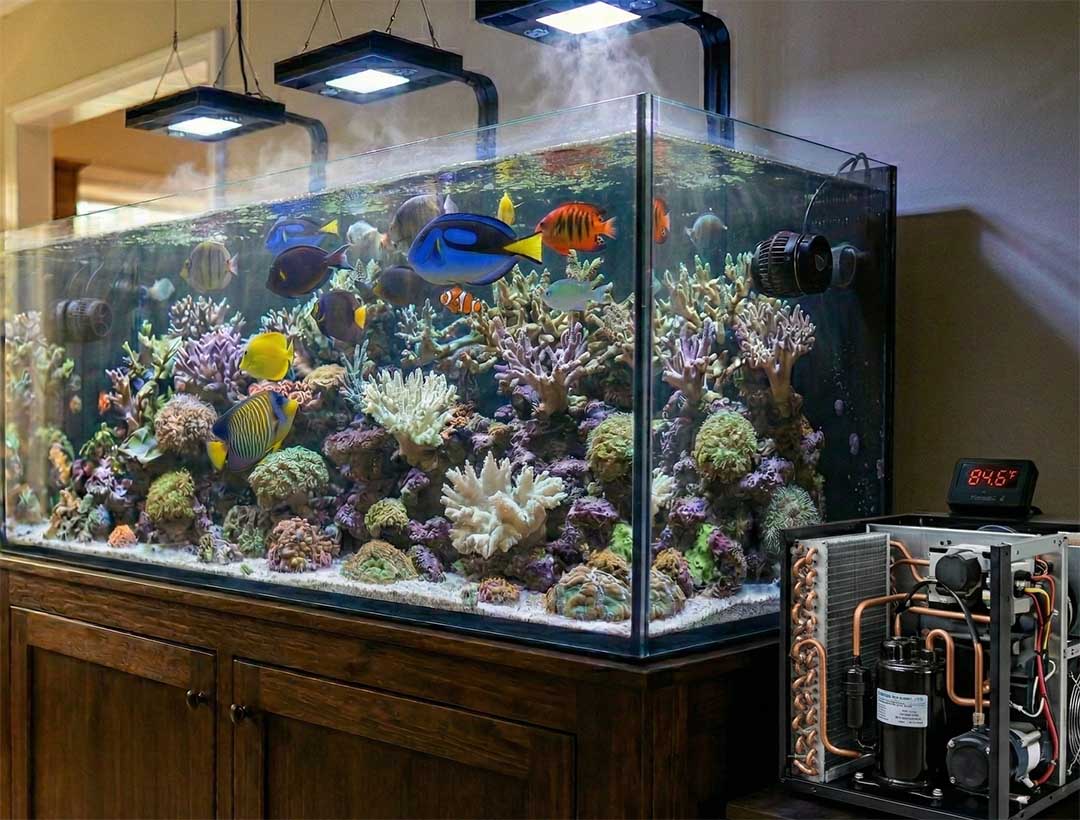
The Expensive Misbelief: “A Fan Is Good Enough”
This is where a lot of money disappears.
Fans can reduce temperature. That part is true. But fans do it through evaporative cooling, which creates a new set of problems:
- faster evaporation
- greater salinity drift in marine tanks
- more top-off dependence
- less stable daily temperature control
A fan is not precision cooling. A fan is a short-term workaround.
If you are running a reef tank with expensive coral, sensitive fish, or a high total system value, unstable workaround cooling is a bad bet.
Increased bacterial activity under heat also puts more pressure on your filtration system. If your filter clogs faster during summer, this is why:
Aquarium Filter Gets Dirty Fast.
Fan vs Chiller: The Real Difference
The real comparison is not “cheap vs expensive.”
It is uncontrolled correction vs controlled stability.
| Cooling Method | What It Does Well | Main Weakness |
|---|---|---|
| Fan | Cheap, simple, lowers temp somewhat | Creates evaporation, instability, and ongoing parameter drift |
| Aquarium Chiller | Holds a target temperature consistently | Higher upfront cost |
The fan saves money today. The chiller protects money tomorrow.
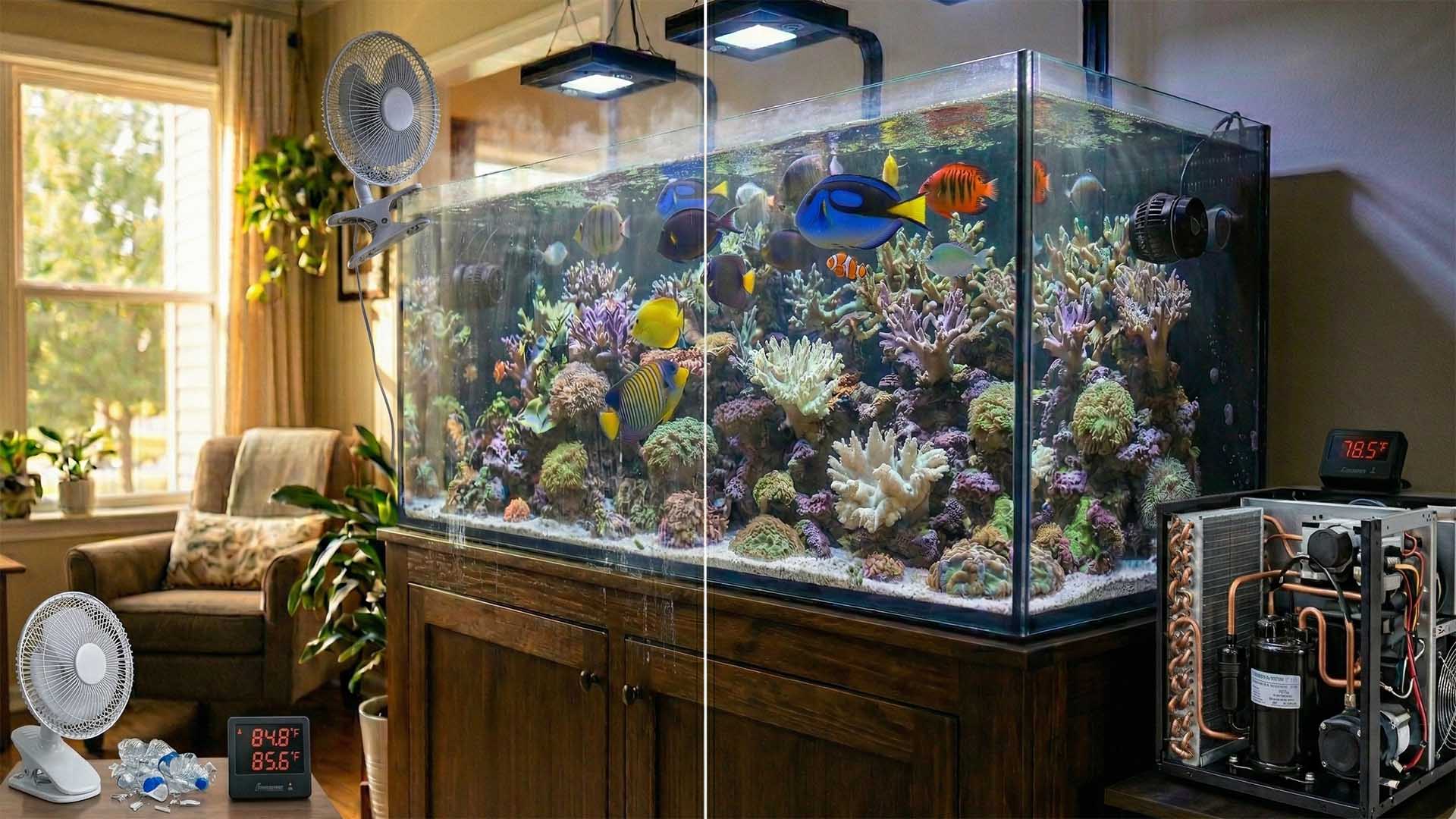
Why a Chiller Is Really “Summer Insurance”
Calling a chiller “insurance” is not marketing language. It is the right mental model.
You do not buy a chiller because your tank is crashing today. You buy one because:
- a heatwave can arrive fast
- your room temperature may change while you are away
- fans may not hold stable cooling across day and night
- one bad summer week can wipe out months or years of growth
If your reef contains a few valuable coral pieces, a premium fish, or sensitive inverts, the risk math gets brutal very quickly.
The $1,000 mistake is not buying the chiller.
The $1,000 mistake is waiting until after the loss to admit you needed one.
Who Actually Needs an Aquarium Chiller?
Not every tank does.
This is important, because blanket advice destroys trust.
You probably do need a chiller if:
- you run a reef tank with coral that hates temperature swings
- your room gets hot in summer and AC is inconsistent
- your tank already runs warm from pumps, lighting, or enclosed cabinetry
- you keep expensive or sensitive marine fish
- you travel or cannot monitor daytime heat spikes closely
You may not need a chiller if:
- your room stays temperature controlled all summer
- your tank is low value and highly resilient
- a fan can hold a truly stable range without creating salinity problems you cannot manage
That said, many hobbyists underestimate how quickly “pretty stable” becomes “not safe enough.”
Why Reef Tanks Are the Highest-Risk Category
Freshwater keepers can often survive small heat swings better than reef keepers. Reef systems are far less forgiving because they stack multiple sensitivities at once:
- coral stress
- oxygen limitations
- evaporation-linked salinity swings
- equipment-generated heat
This is why a reef tank can feel stable until summer exposes the weak point. One season of heat is often enough to show whether the tank was actually controlled or just lucky.
What Summer Heat Does to Corals and Sensitive Fish
Higher temperature increases biological demand at the exact moment oxygen becomes less available. That is a terrible combination.
For corals, this can show up as:
- longer closure
- reduced extension
- slower recovery
- bleaching risk under sustained stress
For fish, it often shows up as:
- surface proximity
- faster respiration
- lower appetite
- weaker disease resistance
The scary part is that these symptoms may appear before your tank ever reaches the dramatic temperature number hobbyists like to argue about online.
Why Summer Heat Creates “False Stability”
One of the worst traps in fishkeeping is false stability. The tank looks fine enough, so the keeper assumes the system is safe. But the real buffer is shrinking.
Summer does this by stacking invisible pressure:
- less oxygen
- higher metabolic demand
- more bacterial consumption
- more evaporation
- less room for error
That is why a tank can run “fine” for days, then suddenly cross the line at night or during a hot afternoon.
This is the same pattern seen in tanks that appear stable but slowly collapse under hidden pressure. If you want to understand that pattern deeper, read:
False Stability in Aquariums.
Cheap Cooling Often Creates New Problems
The hobby usually frames this as a simple money decision. It is not.
Cheap cooling methods often trade one risk for another:
- fans lower temp but increase evaporation
- open lids improve heat release but reduce stability
- frozen bottle tricks create swings instead of control
None of those methods are true insurance. They are emergency improvisations.
Uncontrolled cooling and rapid corrections can create parameter shock, especially in sensitive systems. This is similar to what happens after improper maintenance. Related breakdown:
Fish Die After a Water Change?
What an Aquarium Chiller Actually Buys You
A chiller does not just lower temperature. It buys you:
- predictability
- narrower daily temperature range
- less salinity drift pressure
- less dependence on your presence
- better protection during heat spikes
That is why the real product being sold is not “cooler water.” It is controlled stability.
How to Decide if a Chiller Makes Financial Sense
Do the brutal math instead of the emotional math.
Add up:
- livestock replacement cost
- coral colony value
- the time required to rebuild a damaged reef
- the cost of “temporary fixes” repeated over and over
Now compare that total to the cost of a reliable chiller.
That comparison is usually the moment the purchase stops looking expensive and starts looking rational.
When a Chiller Is Overkill
To keep this honest: yes, sometimes a chiller is overkill.
If you have a small, low-risk setup in a climate-controlled room with low heat input and proven seasonal stability, a chiller may not be necessary. But “I think it should be okay” is not proof. Actual summer data is.
If you are guessing, you are still gambling.
How to Prevent a Summer Crash Before Buying Anything
Even if you decide a chiller is the answer, do the basics first.
- Track daytime and nighttime temperature swing
- Watch fish breathing in the evening
- Monitor evaporation rate
- Know how much room heat your lights and pumps add
- Stop pretending a single daily check equals stable conditions
This tells you whether you need emergency coping tools or real thermal control.
FAQ: Aquarium Chillers in Summer
Do I need an aquarium chiller for a reef tank?
If your reef tank experiences summer heat spikes, unstable room temperature, or costly livestock risk, a chiller is often the most reliable way to protect long-term stability.
Are fans enough to cool an aquarium?
Fans can help, but they rely on evaporation and do not provide the same level of stable temperature control as a chiller. In reef systems, that tradeoff can become expensive.
Can summer heat kill fish even if the tank looks normal?
Yes. Heat reduces oxygen availability while increasing metabolic demand. Fish and corals can decline before obvious visual collapse appears.
Is a chiller worth it for freshwater tanks?
Sometimes. Many freshwater tanks can manage without one, but high-value, sensitive, or heat-exposed systems may still justify controlled cooling.
Scientific Insight: Why Heat Stress Becomes a Tank Crash
Warmer water holds less dissolved oxygen. At the same time, fish, corals, and bacteria all increase metabolic demand as temperature rises. That means hot tanks become more stressful precisely when less oxygen is available.
The U.S. Geological Survey explains the relationship between dissolved oxygen and water conditions, including temperature’s impact on oxygen availability in aquatic systems. The less oxygen your water can hold, the smaller your margin for error becomes. USGS Water Science School
NOAA’s heat-related marine guidance also reinforces how elevated temperature can disrupt aquatic life and push already sensitive systems into stress. While home aquariums are controlled environments, the same basic biological pressure applies. NOAA
In practice, hobbyists experience this as “everything looked fine until summer.” That is not bad luck. It is oxygen, heat, and demand colliding in a closed system.
Closing: A Chiller Is Not a Luxury When the Risk Is Real
The biggest aquarium chiller mistake is thinking of it as optional gear when your tank is already telling you summer is a threat.
If your setup contains real value, real sensitivity, or real heat exposure, a chiller is not a gadget. It is controlled risk management. And in high-end tanks, controlled risk is usually cheaper than rebuilding after the crash.
If you are running a natural or low-tech system, heat behaves very differently compared to controlled setups. See how stability works in those systems:
Self-Sustaining Aquarium Guide.