
If your aquarium plants keep melting, turning transparent, or refusing to grow, the real problem isn’t your lighting, fertilizer, or lack of CO₂ — the real problem is that you’re unknowingly triggering melt during the most vulnerable stage of plant adaptation. In this complete breakdown, we reveal why plants melt after planting, the hidden mistakes most aquarists never notice, and the stability-first method that transforms weak plants into thriving ones in 2025. If you’ve searched “why are my aquarium plants melting,” “aquarium plants not growing,” or “how to stop plant melt,” this is the guide written exactly for you.
Most aquatic plants are grown emersed (above water) at farms. When placed underwater in your tank, plants must perform a biological transformation known as the leaf reset. They shed old emersed leaves, dissolve weak tissues, and rebuild new submerged leaves designed for underwater life. This transformation is normal — but the wrong conditions turn a natural reset into a full collapse. Lighting mistakes, unstable parameters, root starvation, and substrate issues accelerate melt dramatically.
Why Aquarium Plants Keep Melting (The Real Science)
1. Plant Melt Adaptation — The Leaf Reset
When plants switch from air-grown to underwater-grown leaves, the old ones collapse. Emersed-grown tissues lack the internal structure needed for underwater gas exchange, so they melt. This is normal — but it becomes extreme when stress levels are high. Most aquarists mistake this natural reset for a plant “dying,” but in reality, the plant is transitioning to its submerged form.
2. Lighting Mistake — The Sunburn Effect
High-intensity lighting from day one is a major melt trigger. New submerged leaves have not formed yet, so bright light essentially “sunburns” delicate tissue. This causes leaves to become transparent, curl inward, or turn white before melting completely. The fix is simple: start with moderate light and gradually increase over 2–3 weeks.
3. Fertilizer Overload — The Chemical Burn Trap
One of the biggest hidden mistakes is dosing fertilizer immediately — especially if you add iron or strong liquid ferts. New plants cannot uptake nutrients until their root systems anchor and submerged leaves form. Adding fertilizer too early creates a chemical imbalance that burns fresh tissue faster than it develops, leading to severe melt.
4. Dead Substrate Zone — The Starved Roots
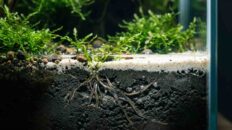
If substrate is old, depleted, compacted, or full of anaerobic pockets, roots suffocate. Without oxygen-rich substrate, root hairs cannot absorb nutrients. Plants then melt from the bottom upward. This is why many aquascapers refresh substrate every 1–2 years and use root tabs only when needed — not randomly.
5. Low-Light Recovery Phase — The Healing Window
After the initial melt, plants require a low-stress environment to rebuild submerged leaves. This “healing phase” is where new shoots emerge. If parameters fluctuate, leaves become twisted, pale, or stalled. This phase determines whether the plant adapts — or collapses completely.
6. Zero-Movement Rule — The No-Touch Law
Every time you touch or reposition the plant, you reset the anchoring process. Micro-roots that were just stabilizing break instantly. The result? A full melt cycle restarts.
If you move it, you reset it.
7. Root Feeding Fix — The Root Recharger
Most plants depend on substrate nutrition far more than water-column fertilizer during Week 1–3. If roots cannot find nutrients, melt accelerates. Once new submerged leaves form, root tabs can help — but applying them too early can burn young roots.
8. Myths Debunked — Why Your Fixes Made Things Worse
Most plant forums tell beginners to “add more light,” “dose more fertilizer,” or “increase circulation.” All of these worsen melt during adaptation. More light = more stress. More fertilizer = more toxicity. More flow = more uprooting. Most aquarists unknowingly sabotage their plants during the reset phase.
9. Bonus Truth — Balance Formula
Strong growth doesn’t come from aggression. It comes from balance. Plants thrive when:
- Lighting is moderate
- Parameters are stable
- Substrate is oxygenated
- Roots anchor without disruption
- Tissue rebuilds slowly over 2–3 weeks
10. Water Clarity Science — The Crystal Method
Clear water increases consistent light penetration, which helps new submerged leaves adapt without sudden intensity spikes. This is why top aquascapers prioritize crystal-clear water in the first 14 days using mechanical filtration and gentle flow.
STOP Doing THIS (Critical Mistakes Causing Melt)
- STOP blasting plants with strong light during Week 1
- STOP dosing random fertilizer without root development
- STOP disturbing substrate around newly planted stems
- STOP moving plants every few days to “adjust placement”
- STOP creating parameter swings during adaptation
- STOP expecting emersed-grown leaves to survive underwater
How to Actually Stop Plant Melt (7-Step Fix)
Step 1 — Reduce Light Intensity (6 hours only)
Start with moderate lighting. A 6-hour photoperiod is ideal for the first two weeks. Too much light creates oxidative stress and accelerates melt.
Step 2 — Keep Parameters Stable
Stability matters more than “perfect numbers.” Keep temperature swings low, maintain hardness consistency, and avoid major water changes early.
Step 3 — DO NOT Touch the Plants
Allow roots to anchor for 14 days. Every movement resets the adaptation cycle.
Step 4 — Strengthen the Substrate
A healthy substrate is the foundation of strong plant growth. Replace compacted substrate or gently oxygenate it before planting.
Step 5 — Feed Roots Correctly
Once submerged leaves form, add root tabs sparingly. Never add them during Week 1.
Step 6 — Use Gentle Water Flow
High flow uproots plants and disturbs substrate. Use gentle circulation to support clarity and oxygenation.
Step 7 — Allow 2–3 Weeks for Adaptation
Full adaptation is not instant. Plants need time to rebuild submerged tissue, anchor roots, and stabilize biologically.
People Also Ask (Aquarium Plant Melt)
Why do my aquarium plants melt after planting?
Because emersed leaves cannot survive underwater. Plants must rebuild submerged leaves, and stress accelerates melt.
How long does plant melt last?
Between 7–21 days depending on species, stability, and lighting intensity.
Should I remove melted leaves?
Yes. Melted leaves decay quickly and invite algae. Remove gently without disturbing roots.
Why are my plants not growing even with fertilizer?
Fertilizer doesn’t help until roots anchor and submerged leaves develop. Early dosing often makes things worse.
How do I stop transparent or ghost-like leaves?
Reduce light intensity, stabilize parameters, and avoid touching the plant. Ghost leaves indicate adaptation stress.
Do root tabs stop plant melt?
Not during Week 1. Root tabs help only after submerged leaves form; adding them too early burns new roots.
FAQ – Common Questions About Aquarium Plant Melt
How long does it take for aquarium plants to stop melting?
Most plants complete their adaptation phase in 2–3 weeks. Species like Cryptocoryne may take longer, but consistent lighting and stable parameters dramatically shorten melt duration.
Should I cut off melted or transparent leaves?
Yes. Melted leaves decay quickly and encourage algae growth. Trim them gently without disturbing the root base to prevent another adaptation reset.
Why are my plants not growing even though I use fertilizer?
Fertilizer only works when plants have stable roots and formed submerged leaves. Early dosing often burns young tissue and slows growth. Allow plants to anchor first.
Do I need CO₂ to prevent plant melt?
No. Melt depends more on stability than CO₂ injection. Low-tech tanks grow beautifully if lighting is controlled, the substrate is healthy, and plants are not moved.
Is it normal for new plants to lose all their emersed leaves?
Yes. Many aquatic plants naturally shed emersed leaves after planting. This reset is required for the plant to build underwater leaves that can properly photosynthesize.
How do I know if my substrate is causing melt?
If your plants show weak or brown roots, slow anchoring, or melt from the bottom upward, your substrate may be compacted, anaerobic, or depleted.
Will increasing light stop the melt?
No. Increasing light is one of the most harmful responses to melt. Higher light amplifies stress and accelerates tissue breakdown.
Can water clarity affect plant recovery?
Yes. Clear water provides consistent light penetration, reduces stress, and helps new submerged leaves adapt more evenly.
Internal Links – Related Guides from FishTank Mastery
If you’re dealing with plant melt, it often helps to understand how schooling fish behavior influences tank stability. Our guide on
the best and worst schooling fish breaks down species that support calm, stable planted setups and those that disrupt them.
Aggression from large species can also indirectly affect plant adaptation. If your tank houses demanding or territorial fish, read our analysis of
monster fish that destroy aquariums to avoid species that uproot plants or disturb substrate.
Healthy planted tanks often rely on a strong clean-up crew to maintain clarity and nutrient balance. For a complete breakdown, explore our
2025 clean-up crew guide to understand which species actually support plant recovery.
If you’re curious about schooling behavior and want calmer mid-water activity in your planted setup, you’ll benefit from the second part of our expanded schooling series:
Don’t Buy These Schooling Fish (Part 2).
Finally, if your planted tank includes a Betta or you’re planning a species mix, our guide on
Betta tank mates that actually work shows compatible species that won’t nip, uproot, or stress your plants during the adaptation phase.
Scientific References
Many of the phenomena behind plant melt, including emersed-to-submerged transitions and leaf restructuring, are well documented in biological databases such as
FishBase. Their species-level habitat and physiology notes explain why plants experience drastic environmental shocks when submerged.
Studies published through
ScienceDirect help clarify how lighting intensity and photoperiod changes impact leaf tissue stability. Research on light-driven oxidative stress directly supports the “sunburn effect” described in this article.
Environmental biology research available on
SpringerLink also explains how substrate oxygenation, nutrient availability, and anaerobic zones influence root development, anchoring strength, and melt severity.
Water chemistry fluctuations and stress hormones in aquatic plants are further supported by studies found on
Oxford Academic. Consistent KH, GH, and temperature levels significantly reduce stress-induced melt.
Finally, plant physiology research published by
FEMS Microbiology Letters highlights how microbial communities around roots influence nutrient absorption and early adaptation success, reinforcing the importance of substrate health during Weeks 1–3.
Watch Next – Recommended Videos
For aquarists who want to continue improving plant health and overall tank stability, these guides offer deeper insight into lighting, algae control, and biological balance: