
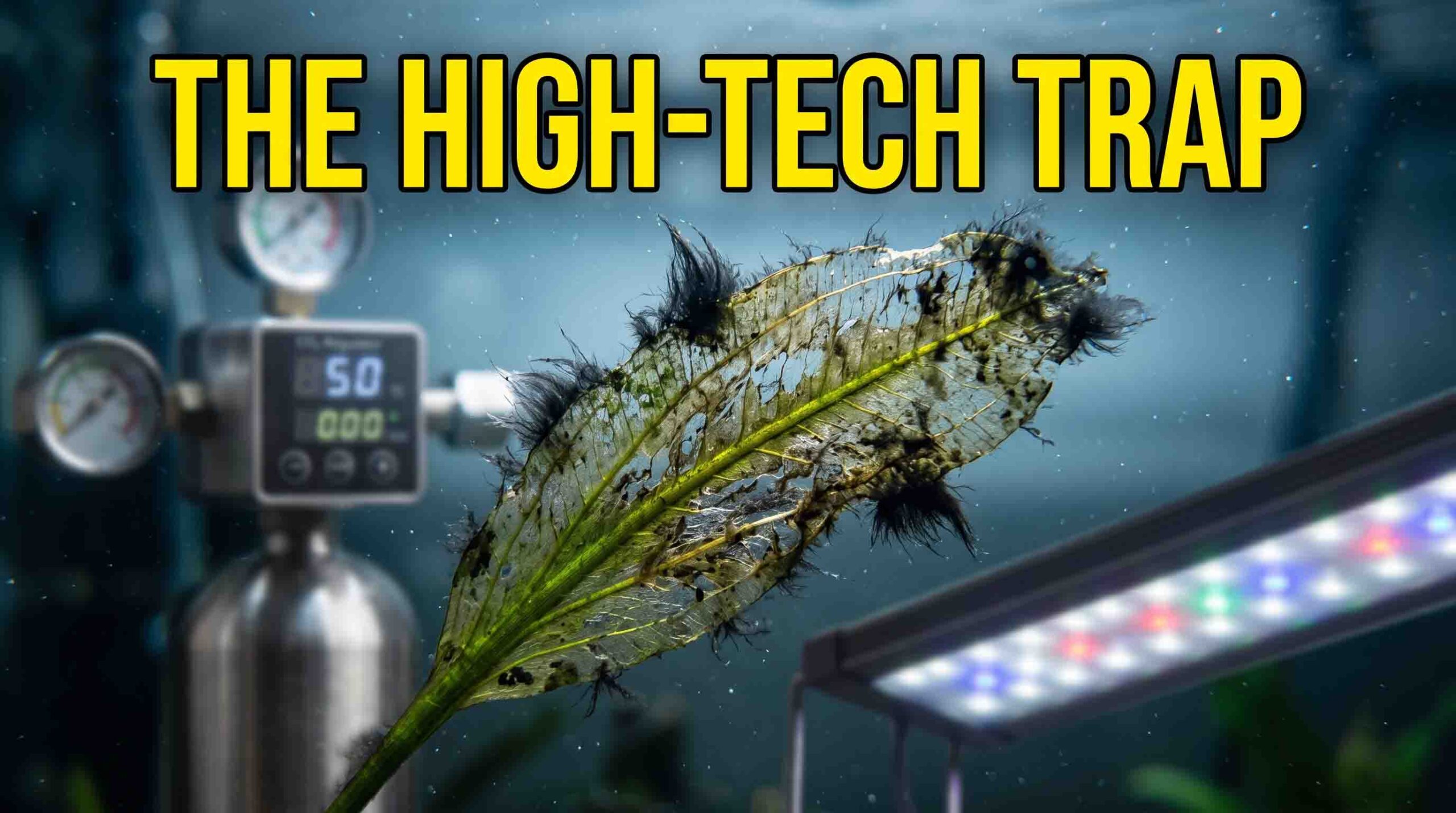
High-Tech Planted Aquarium Setup: Cold Water Trap
You set up your tank, bought the best gear, planted those beautiful aquatic greens, and felt like an aquascaping genius. But two weeks later, you are staring at a glass box full of melting leaves, brown mush, and aggressive algae. Sound familiar?
When plants start dying, the beginner instinct is almost always to spend more money. You assume the plants are starving, so you invest in a high-tech planted aquarium setup. You buy a professional CO2 system, upgrade to a premium LED fixture, and pour in expensive nutrient-rich aquasoil.
But here is the harsh reality that most pet stores will never tell you: If you are running a cold water tank (no heater) or a goldfish setup, throwing expensive gear at it is the fastest way to burn your money.
Cold water changes the rules of aquarium biology. And forcing high-tech equipment into a low-temperature ecosystem doesn’t speed up plant growth—it completely breaks the tank.
The Biological Speed Limit Nobody Explains
Before you spend another dollar on aquarium equipment, you need to understand how aquatic plants actually function underwater. It all comes down to metabolism.
In a standard tropical tank (heated to around 78°F or 26°C), plant metabolism runs fast. The plants consume nutrients quickly, absorb CO2 rapidly, and push out new leaves almost daily. This is the environment where high-tech gear makes sense. The gear fuels the speed.
However, in a room-temperature tank or a cold water setup (around 65°F to 70°F), the entire ecosystem hits the snooze button.
Cold water slows down plant metabolism drastically. When you place a newly purchased plant—which was likely grown emersed (out of water) in a hot, humid greenhouse—into cold water, it goes into severe shock. It drops its old leaves to conserve energy. This is what we call “plant melt.”
The beginner mistake is seeing this melt and diagnosing it as starvation. You think, “My plants need more light and more CO2!”
No, they don’t. They just need time to adapt to a slow system. When you inject high-energy variables into a low-energy system, the plants cannot physically use them. But do you know what organism thrives in cold water with excess light and nutrients?
Algae.
The True Cost of the Cold Water Trap (Investment Analysis)
Let’s look at the financial damage. Hobbyists routinely waste hundreds of dollars trying to fix a cold water plant problem with tropical high-tech solutions. If you are assessing your planted tank investment, here is how the numbers usually break down when you mix the wrong gear with the wrong temperature:
| Setup Type | Estimated Cost | Algae Risk | Maintenance Demand | Long-Term Success in Cold Water |
|---|---|---|---|---|
| High-Tech Trap (CO2 + WRGB LED + Aquasoil) | $400 – $800+ | Extreme (BBA, Hair Algae) | Heavy (50% weekly water changes) | Very Low (Constant crashes) |
| Low-Tech Steady (Inert Sand + Root Tabs + Standard LED) | $60 – $120 | Low to Moderate | Minimal (20% bi-weekly) | High (Stable and lasting) |
The data is clear. Spending $600 on a high-tech system for a room-temperature tank doesn’t give you a lush aquascape; it gives you a very expensive algae farm.
Let’s break down exactly why each piece of premium gear fails when the water gets cold, starting with the most misunderstood upgrade in the hobby: CO2 injection.
The High-Tech Trap: Why Premium Gear Destroys Cold Water Tanks
There is a dangerous myth circulating in modern aquascaping: “If your plants are failing, your gear isn’t expensive enough.” This lie sells a lot of equipment, but it completely ignores aquatic biology.
When you are running a cold water setup—whether it is a room-temperature community tank or a dedicated goldfish aquarium—you are operating a low-energy ecosystem. Plant metabolism is strictly governed by water temperature. At 65°F to 68°F (18°C – 20°C), plants are not trying to win a race. They are prioritizing survival over rapid growth.
When you force a high-tech planted aquarium setup onto a low-temperature biological system, the tank doesn’t just struggle; it violently crashes. Let’s break down exactly why the top three most expensive upgrades will actually ruin your no-heater aquarium.
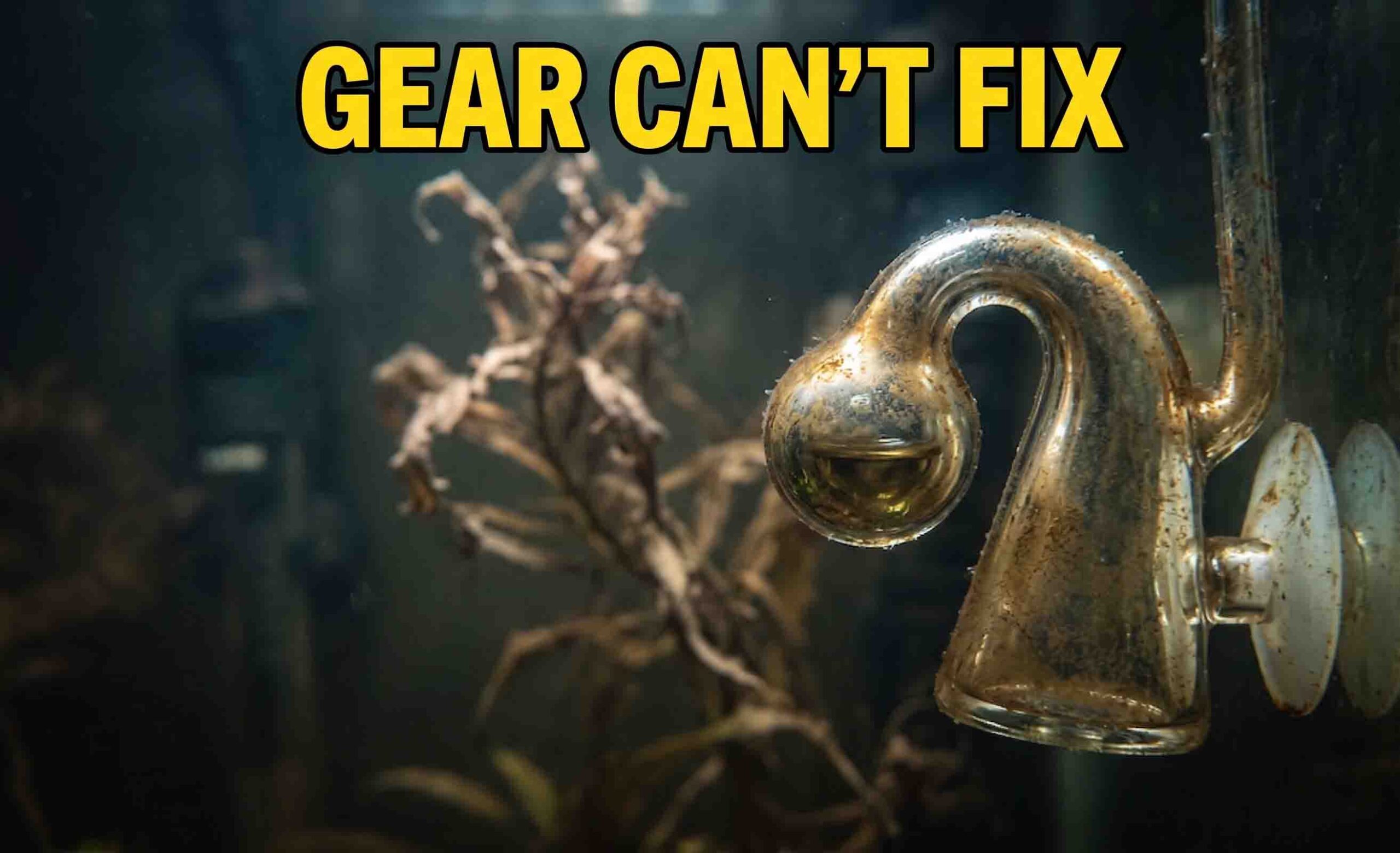
1. Automated CO2 Systems: The pH Crash Generator
Pressurized CO2 is the holy grail of tropical aquascaping. In an 80°F (26°C) tank with fast-growing stem plants, CO2 injection acts like a supercharger. The plants consume the carbon rapidly, outcompeting algae and producing lush, dense growth.
But in cold water, that supercharger becomes a poison.
Because the plants are cold, their cellular respiration is moving in slow motion. If you inject 2 or 3 bubbles per second of CO2 into a cold water tank, the plants simply cannot absorb it. They don’t have the metabolic speed to process the gas. So, what happens to all that unused carbon dioxide?
It dissolves into the water column, forming carbonic acid. Within hours, your pH levels plummet. This sudden acidic swing burns the protective slime coat off your cold water fish and stresses your beneficial bacteria. You just paid $200 for a professional CO2 system for a planted tank, and all it did was gas your fish and melt your slow-growing plants faster.
2. Smart WRGB LEDs and “AI” Light Controllers
We are living in the era of smart aquariums. Today, you can buy a premium WRGB LED fixture equipped with Bluetooth, app control, and AI-driven algorithms that mimic natural sunrise, midday intensity, and sunset.
It sounds incredibly advanced. But here is the fatal flaw: These smart algorithms are programmed for tropical metabolisms.
Your smartphone app does not know that your water is 65°F. When the AI controller ramps up the light intensity to 100% at midday, it assumes your plants are awake, hungry, and ready to photosynthesize at maximum capacity. But your cold water plants are sluggish. They take one look at that massive aquarium LED lighting intensity and essentially close their blinds.
Since the plants cannot use that high-PAR (Photosynthetically Active Radiation) light energy, algae happily steps in. Algae does not care about cold water. It is opportunistic. Within a week of running a high-intensity smart light over a cold water tank, you will be scrubbing Green Spot Algae off the glass and fighting Black Beard Algae (BBA) on your driftwood. You cannot fix a biological speed limit with a smartphone app.
3. Premium Aquasoil: The Ammonia Bomb
Active substrates (aquasoils) are fantastic for high-demand setups. They are packed with baked-in nutrients, nitrogen, and ammonia to kickstart heavy root feeders. In a warm tank, plants explode with growth as they feed on this rich soil.
In a cold water tank, placing slow-growing plants into a premium aquasoil is like serving a five-course steak dinner to someone who just woke up from a coma. They cannot eat it.
Because the roots are inactive due to the low temperature, the aquasoil continues to leach massive amounts of ammonia and excess nutrients directly into the water column. Without fast-growing plants to absorb this premium aquarium substrate leaching, your water turns cloudy, your nitrate levels spike, and your tank becomes a toxic, green soup.
Stop Buying Gear, Start Buying the Right Plants
The secret to a thriving cold water aquarium is incredibly simple, yet most beginners completely miss it: You do not need to speed up the tank with gear; you need to choose plants built for the slow lane.
Instead of wasting money on CO2 regulators and AI lighting, you must select species that naturally thrive in low-temperature, low-energy environments. We spent months testing the hardiest species that can survive without heaters, without CO2, and without expensive lights.
Watch our full breakdown below to discover the exact 10 plants that will survive your room-temperature setup, including the rhizome survivors and cold-water floating plants that beginners constantly overlook.
(If you are keeping goldfish in that cold water tank, pay special attention to Plant #6 and #7 in the video, or your setup will quickly become an expensive salad bar.)
Is Your Tank Running Too Hot?
We’ve talked extensively about cold water setups, but aquarium plants are highly temperature-dependent. If your tank runs on the tropical side, applying these “cold water” rules will result in stunted, dying plants. If your tank temperature consistently stays above 76°F (24°C), you need a completely different plant palette. Check out our detailed guide on Aquarium Plants for Warm Water Tanks to ensure you are choosing the right biological match for your specific setup.
How to Build a Cold Water Planted Tank That Actually Works
If high-tech gear is essentially a death sentence for a room-temperature ecosystem, how do you actually build a lush, green planted tank without a heater? The secret isn’t spending more money; it’s changing your strategy. You need to build a system that respects the biological speed limit.
Here is the exact, low-stress blueprint we use for cold water setups and goldfish aquariums.
1. The Inert Foundation (Ditch the Aquasoil)
Instead of active, nutrient-leaching soils, use an inert substrate like standard aquarium sand or smooth gravel. Inert substrates do not release ammonia into the water column, meaning your tank won’t turn into a green swamp while your plants are slowly adapting.
If you want to keep heavy root feeders like the Amazon Sword in cold water, simply push a high-quality root tab deep into the sand right beneath the plant. This gives the roots a stable, slow-release food source without polluting the water column.
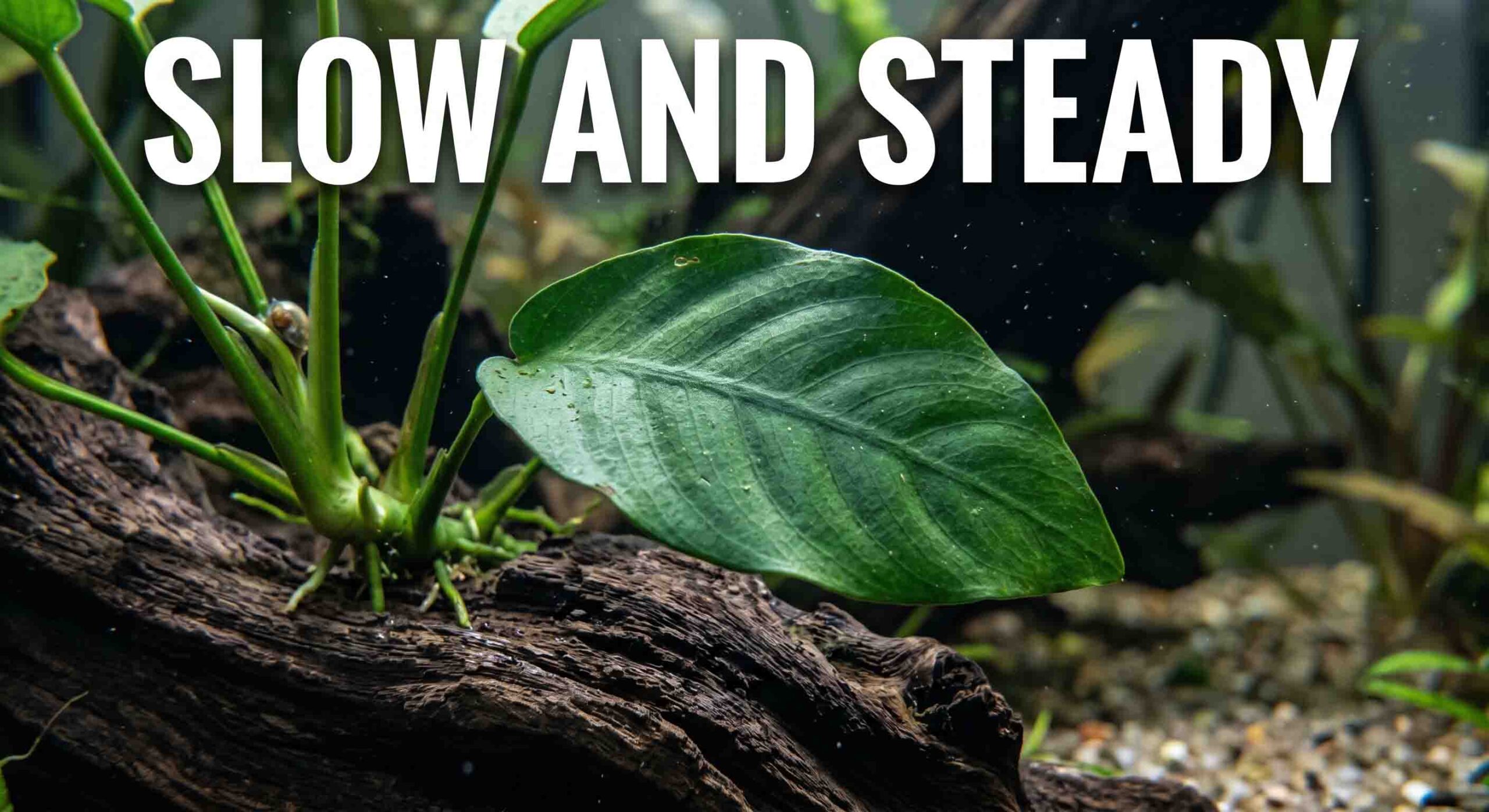
2. Rely on Epiphytes and Rhizome Plants
If you want a bulletproof cold water tank, rhizome plants are your best friends. Species like Java Fern, Anubias, and Bolbitis are naturally slow growers. They do not care that the water is 65°F because they were never in a rush to begin with.
The golden rule here: Do not bury the rhizome. Attach these plants to driftwood or rocks using superglue or thread. They pull whatever minimal nutrients they need directly from the water column. They are practically indestructible, provided you leave them alone.
3. Use Floating “Nutrient Sponges”
Because your main plants will be growing slowly, you need something to absorb the excess fish waste before algae takes over. This is where floating or fast-growing stem plants come in. Hornwort, Anacharis (Elodea), and Water Sprite are cold water classics.
They act as natural chemical filtration, pulling nitrates out of the water efficiently. Plus, if you are keeping goldfish, these plants double as a healthy, natural snack.
The 10 Best Plants for No-Heater Tanks
You now know why you shouldn’t force tropical speed into a cold water tank. The next step is choosing the exact plant species that are biologically designed to thrive in this exact environment.
We actually put together a complete, ranked breakdown of the hardiest, most resilient cold water plants in the hobby. If you are tired of watching your expensive plants melt into mush, watch our full guide below to see exactly what you should be planting instead.
The Science of Cold Water: Why Metabolism Dictates Gear
To truly understand why your high-tech gear is failing, you have to look at the science of aquatic biology. In biology, there is a principle known as the Q10 Temperature Coefficient. This rule states that for every 10°C (18°F) drop in temperature, a plant’s metabolic rate roughly halves.
When you drop an Amazon Sword from a tropical 78°F tank into a 60°F unheated setup, its nutrient and CO2 demands drop by more than 50%. According to studies on aquatic plant respiration, forcing high-intensity Photosynthetically Active Radiation (PAR) onto a metabolically slow plant induces photo-inhibition. The plant shuts down to protect its cells from light toxicity, leaving all that expensive light and fertilizer exclusively for algae to consume. (For a deeper dive into aquatic metabolic rates, refer to biological studies on Q10 temperature coefficients in aquatic ecosystems).
What Most People Get Wrong: Beginners assume that a melting plant needs to be “saved” with more fertilizer. Adding liquid fertilizer to a melting plant in a cold tank is like pouring gasoline on a fire. You are not feeding the plant; you are feeding the impending algae bloom.
How to Rescue a Melting Plant in a No-Heater Tank
If you have already made the mistake of overpowering your cold water tank and your plants are melting, do not panic. Follow these exact steps to stabilize the ecosystem before algae takes over completely.
- Step 1: Stop All Liquid Fertilizers Immediately. Cut off the food supply to the water column. The plants cannot use it right now, and you need to starve the algae.
- Step 2: Reduce Lighting to 5 Hours. Dim your high-tech LED or physically raise it higher above the tank. Limit the photoperiod to a maximum of 5 to 6 hours until new growth appears.
- Step 3: Trim the Dead Matter. Snip off any brown, transparent, or mushy leaves. Decaying organic matter creates ammonia spikes, which act as a direct trigger for Black Beard Algae (BBA).
- Step 4: Do Not Move the Plant. Every time you uproot a struggling plant to “reposition” it, you reset its adaptation clock to zero. Leave it alone.
Master Your Cold Water Ecosystem (Related Guides)
A thriving no-heater tank is about balancing the entire ecosystem, not just the plants. If you want to master the art of low-tech, stable aquariums, you need to align your fish stocking and maintenance habits as well. Continue building your knowledge with these crucial guides:
- Stocking the Right Fish: Not all fish can handle cold water. Pair your resilient plants with the right livestock by exploring the 7 Coldwater Aquarium Fish That Thrive with NO Heater.
- Fixing Core Mistakes: If you are still struggling with plant health, you might be making a fundamental biological error. Find out what it is in our guide: STOP Doing THIS If You Want Thriving Aquarium Plants.
- Water Clarity Issues: Did that premium aquasoil turn your tank cloudy? Do not do a massive water change yet. Read our step-by-step guide on How to Fix Cloudy Aquarium Water FAST (Don’t Wait).
People Also Ask (FAQ)
Can I put tropical aquarium plants in cold water?
Some hardy tropical plants, like Anubias and Java Fern, can adapt to cold water (60°F – 68°F) because they are naturally slow growers with low metabolic demands. However, fast-growing tropical stem plants will typically melt and rot because the low temperature halts their cellular respiration.
How long does aquarium plant melt last?
In a heated tank, transition melt lasts 1 to 3 weeks. In a cold water tank, this process can take 3 to 6 weeks. The lower the temperature, the longer the plant takes to shed its emersed leaves and grow new, submersed leaves suited for a low-energy environment.
Why is my cold water tank full of algae?
Algae in a cold water tank is almost always caused by an imbalance between lighting intensity and plant metabolism. If you use a high-tech light without a heater, the plants cannot process the light energy, leaving the excess energy for opportunistic algae to consume.
Final Thoughts: Patience Saves Money
The most expensive mistake you can make in fishkeeping is trying to buy your way out of a biological process. When a plant melts in a no-heater tank, it is adapting. When it grows slowly, it is surviving.
Stop throwing high-intensity lights and pressurized CO2 at a system that just wants to take a nap. Dial back the lights to 6 hours a day, use inert substrates, pick the right slow-growing species, and let the ecosystem stabilize at its own pace.
If you completely switch gears and decide to set up a tropical, heated tank in the future, the rules flip entirely. You can check out our guide on 10 Warm Water Aquarium Plants That WON’T Melt to see how different that environment truly is.
So, what about your setup? What “easy” beginner plant completely melted in your cold water tank even though everyone swore it would survive? Drop your story in the comments below—we have all been there, and your experience might save another beginner from making the same expensive mistake.
Until next time, keep your tanks balanced, your systems steady, and your curiosity flowing.