
The 2-Inch Monster Fish Illusion and Delayed Biological Failure
Planning to buy a petsmart monster fish? Before you bring home that 2-inch baby fish, you must avoid pet store lies and understand the delayed biological failure that causes sudden tank crashes.
You walk down the brightly lit aisle of your local pet store, and there it is. A tiny, two-inch fish swimming innocently in a bare display tank for five dollars. The plastic label on the glass clearly says it needs a fifty-five-gallon aquarium. You have a fifty-five-gallon aquarium running perfectly in your living room. It seems like simple, foolproof math. But this is where the biological trap begins.
The person scooping your fish is a retail worker doing their best, not a marine biologist. Their job is to clear inventory, and they are dealing with massive centralized filtration systems designed for temporary survival. The label on the tank is written for the fish as it exists today, not for the biological machine it will become in six months. When you buy a juvenile monster fish without understanding its future metabolism, you fall into a cycle of delayed failure.
Watch the video above to see exactly how these fish outgrow tanks in real time, then continue reading to understand the biological math behind it.
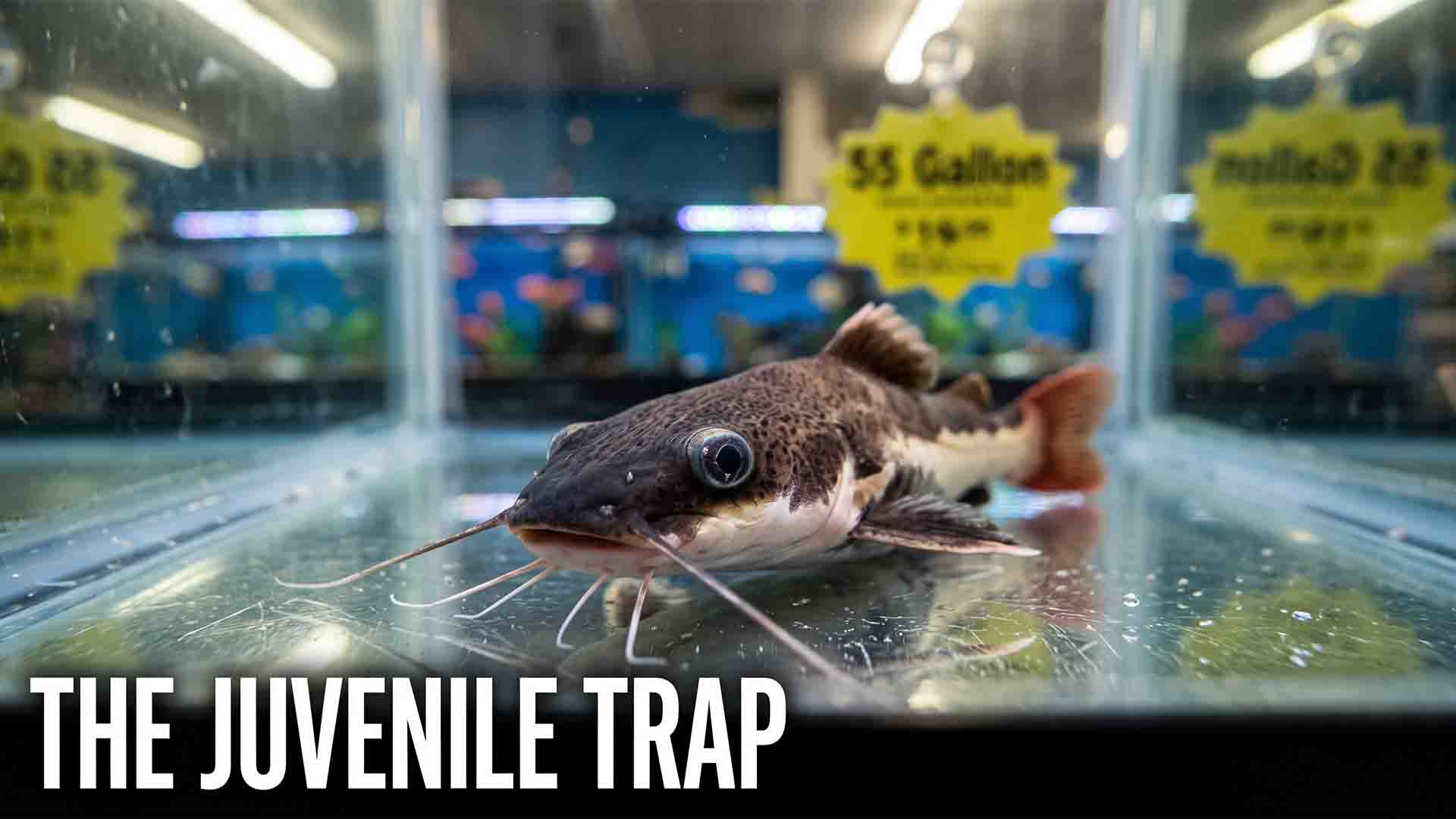
The 2-inch illusion: What big box stores sell vs. what biology demands.
The Biological Math: Mass vs. Length (Cube-Square Law)
Most beginners believe that a fish will only grow to the size of its tank. This is a complete myth. Small tanks do not fail faster; small mistakes just do not dilute. The reality of keeping a freshwater tank buster is dictated by the Cube-Square Law applied to biology.
As a fish doubles in physical length, its mass actually multiplies by eight. It becomes a biological freight train, and the momentum of that freight train—the Bioload Momentum—simply crushes your filter. If your tank looked perfect on paper, but that two-inch fish started turning the water cloudy every three days, you cannot blame the filter. You must blame the failure to calculate future mass.
This is why understanding how you cycle and manage your aquarium bioload momentum is critical before bringing home any large species.
The System Crashers: Worst Monster Fish to Buy at PetSmart
These are the fish that look manageable as juveniles but will systematically destroy the balance of a standard community aquarium. Avoid these worst aquarium fish unless you have hundreds of gallons of water and specialized filtration.
The Pacu: The Aquatic Cow
People buy these out of pure curiosity because they look exactly like juvenile piranhas. They are incredibly cheap, they look tough, and at two inches, they seem manageable. But what the label doesn’t tell you is that a Pacu is basically an aquatic cow.
They consume massive amounts of organic matter and turn the bottom of your tank into a toxic waste dump in a matter of hours. They do not just outgrow the physical space of your tank; they outgrow the biological capacity of your filter so fast that your water parameters will swing violently overnight. Dropping a Pacu into a standard community tank is a guaranteed way to collapse your nitrogen cycle.
The Bala Shark: The Runway Problem
If the Pacu breaks the tank with sheer biological mass, the Bala Shark just runs out of runway. The store label might say they fit perfectly in a medium-sized tank, but water volume is not the same thing as swimming velocity.
Bala Sharks are open-water sprinters. They do not need fifty gallons of standing water; they need eight feet of uninterrupted horizontal swimming space. Trapping them in a standard four-foot tank creates immense Invisible Pressure. As they grow, they become highly stressed, erratic, and constantly pace the glass. This relentless motion stresses out every other fish sharing the water and disrupts the entire resting ecosystem of your monster fish tank setup requirements.
The Iridescent Shark: The Panic Machine
While the Bala Shark paces the glass, the Iridescent Shark will physically shatter it. You see these tiny, sleek sharks swimming nervously together in the store. What you do not see is their natural behavior as they age. They are skittish giants with hyper-sensitive lateral lines. They live in a permanent state of flight. When you simply walk past the tank, or if you just turn on the room light, they panic.
They slam into the glass at full speed, shattering glass heaters, knocking over heavy rocks, and causing severe physical trauma to themselves. You simply cannot keep a high-speed panic machine in a static glass box. The physical damage is immediate, and the constant stress completely destroys their immune system.
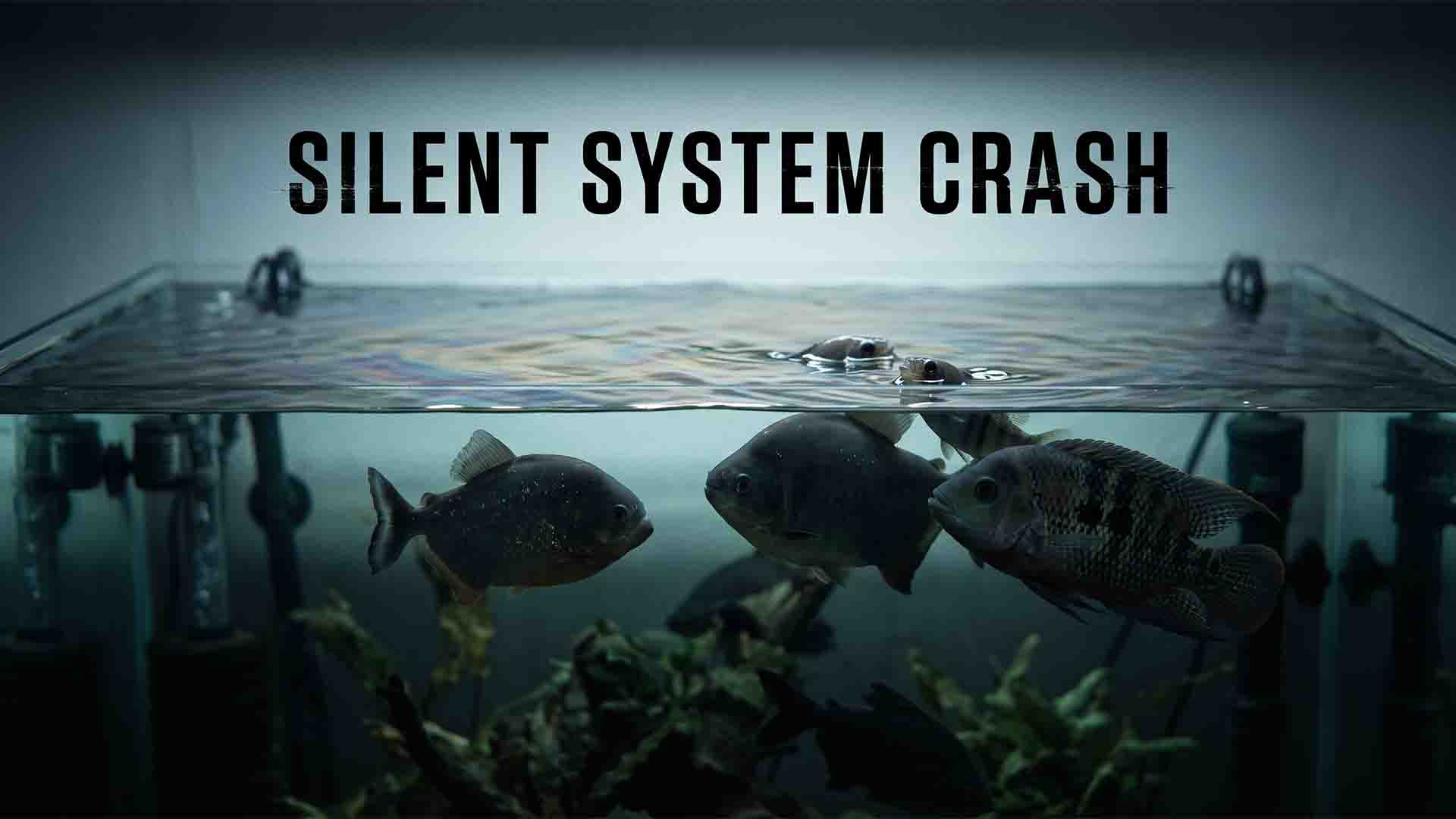
Clear water does not mean stable water. Invisible pressure builds before the crash.
The Redtail Catfish: The Biological Black Hole
The absolute ultimate biological black hole is the Redtail Catfish. As a baby, it is sold as a cute, highly active bottom feeder. Within a single year, it transforms into an apex predator that views your entire community tank as an all-you-can-eat buffet.
The real danger is not just that it eats your expensive tank mates. The invisible danger is the resulting ammonia spike. When a massive fish consumes large protein sources at once, the nitrifying bacteria simply cannot multiply fast enough to catch up to the freight train. The system crashes, the water turns milky white, and the oxygen drops to lethal levels before you even wake up. If you are wondering why did my perfectly clear fish tank crash, a sudden bioload surge from a predator is often the culprit.
The Translators: Best Monster Fish for Large Aquariums
If you want that monster fish aesthetic without the guaranteed system collapse, you need “The Translators.” These are the fish that respect the boundaries of a closed glass box and have metabolisms that your filtration can actually manage.
The Green Severum: The Working-Class Discus
If you want a massive, beautiful fish that immediately becomes the visual centerpiece of your tank, the Green Severum is the safest pick. Unlike the highly aggressive monsters that patrol the middle of the water column looking for a fight, a Severum is generally peaceful and patient.
They might occasionally eat a soft leaf if you do not feed them enough greens, but they do not actively hunt down their smaller tank mates. Their biological footprint is completely predictable, and their temperament is incredibly stable, making them an excellent choice for large community setups.
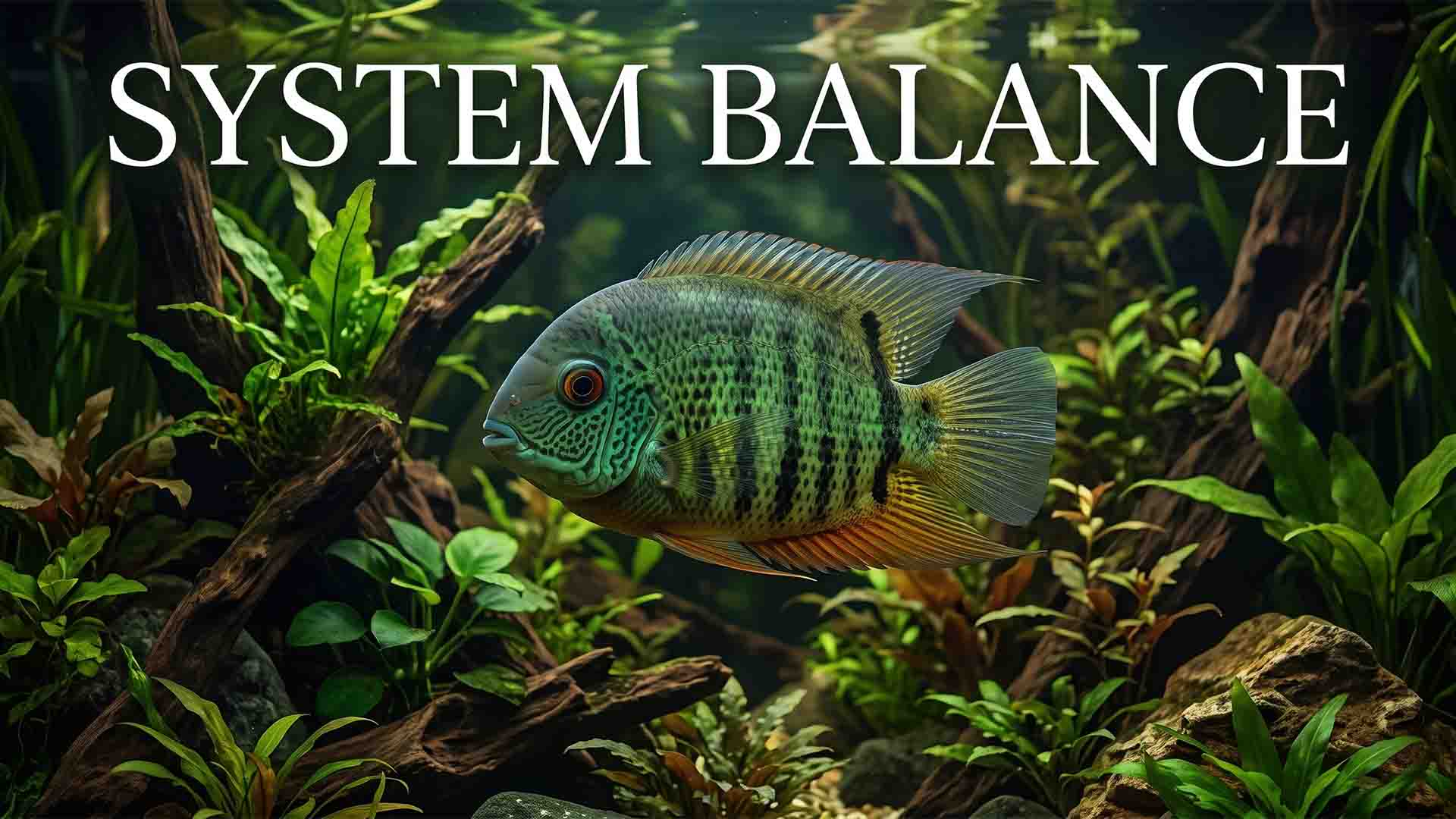
The Green Severum: A working-class giant that respects the biological limits of your tank.
The Blood Parrot Cichlid: The Safest Giant
If the Severum is peaceful by nature, the Blood Parrot Cichlid is peaceful by design. These are the safest giants you can buy. They get surprisingly large, look incredibly bold, and have the highly interactive personality of a water dog.
Their genetic structure gives your tank a massive advantage. Their mouth is physically deformed in a way that prevents them from doing serious damage. Even if they get territorial and try to aggressively bite another fish, they usually cannot lock on. You get the impressive size and intense attitude of a monster fish, without the lethal consequences.
The Senegal Bichir: The Armored Survivor
Often labeled as the Dinosaur Eel, this is the best-kept secret at any chain store. Unlike a fast-moving shark, the Bichir is a slow, highly methodical bottom dweller. It has a very slow metabolism, which means its daily bioload is highly manageable for a standard canister filter.
It even has a modified lung that allows it to breathe atmospheric air directly from the surface, meaning it will not instantly suffocate if your water oxygen drops slightly overnight. It is an ancient survivor equipped with hard armor-like scales that works seamlessly with your system, not against it.
The Oscar: The Ultimate Solo Project
The absolute best monster fish you can buy is the Oscar. But let us be entirely clear: Oscars are heavy polluters. They will absolutely destroy a peaceful community tank.
However, if you keep an Oscar entirely alone in a seventy-five-gallon tank or larger, with heavily oversized filtration, they are the most intelligent wet pet you will ever own in this hobby. They recognize your face, beg for food, and literally rearrange the rocks exactly how they want them. You just have to build the entire system strictly around them. If you are ready for this commitment, check out our deep dive into the ultimate Oscar fish setup and diet plan.
Monster Fish Growth & Bioload Momentum (Data Table)
To truly understand why some fish crash tanks and others thrive, look at how their mass scales over time. This table illustrates the delayed biological failure.
| Species | Retail Size | Adult Size | Bioload Momentum | Min. Tank (Adult) |
|---|---|---|---|---|
| Redtail Catfish (Avoid) | 2-4 inches | 3-4+ feet | Extreme | Indoor Pond (1000+ Gal) |
| Pacu (Avoid) | 2 inches | 2-3 feet | Extreme | 600+ Gallons |
| Oscar Fish (Best) | 2 inches | 12-14 inches | High (Manageable) | 75+ Gallons (Solo) |
| Senegal Bichir (Best) | 3 inches | 12-14 inches | Low (Slow Metabolism) | 55+ Gallons |
The Science Behind the Crash (Scientific Truths)
To move past the beginner trap, we must understand the biological mechanics that drive these failures. This is not about opinion; it is about aquatic science.
Metabolic Scaling and the Cube-Square Law: When a Pacu or Redtail Catfish grows from two inches to eight inches, it has not just quadrupled in length; its volume and mass have increased exponentially. This rapid mass accumulation requires a corresponding increase in oxygen consumption and waste production. According to morphometric studies and growth modeling recorded in FishBase, the metabolic output of these species scales in a way that quickly overwhelms closed-system nitrification cycles, leading to inevitable ammonia spikes. Read the study.
Sensory Mechanics and Kinematic Stress: Species like the Iridescent Shark and Bala Shark are not just “fast swimmers”; they possess highly developed sensory organs meant for vast, open river systems. Research published in Springer detailing the sensory biology of Pangasiidae reveals that their lateral line systems are hyper-sensitive to pressure changes and physical boundaries. Confining them to a static, four-foot glass box creates a state of permanent kinematic stress, leading to erratic behavior, immune system suppression, and physical trauma. Read the study.
Nitrogenous Waste Overload (Microbial Disruption): The sudden biological crash caused by predatory monster fish eating their tank mates is a well-documented phenomenon in aquatic science. ScienceDirect publications on ammonia toxicity and closed-system aquaculture explain that a sudden influx of complex proteins (a digested tank mate) triggers a massive release of nitrogenous waste. The existing colonies of nitrifying bacteria simply cannot reproduce fast enough to process this sudden “freight train” of ammonia, leading to rapid, toxic microbial disruption and a lethal drop in dissolved oxygen. Read the study.
People Also Ask (PAA)
Why do tank buster fish cause cloudy water?
Tank busters like Pacus and Redtail Catfish cause cloudy water because their rapid growth exponentially increases their biological waste output. This massive bioload overwhelms the nitrifying bacteria in your filter, leading to a bacterial bloom and toxic ammonia spikes before the tank can adapt.
Can a Bala Shark live in a 55-gallon tank?
No. While a 55-gallon tank provides enough water volume for a juvenile, adult Bala Sharks require massive horizontal swimming space—typically 8 feet in length—because they are high-speed open-water swimmers. Confining them causes severe kinematic stress, erratic pacing, and physical injury.
What is the 1 inch per gallon rule and is it accurate?
The “1 inch of fish per gallon of water” rule is mathematically flawed and dangerous, especially for monster fish. It ignores the Cube-Square Law; a fish’s biological mass multiplies by eight when its length doubles. Relying on this rule guarantees a collapsed nitrogen cycle when keeping large species.
Are Blood Parrot Cichlids aggressive?
Blood Parrot Cichlids display the territorial and bold behaviors typical of large cichlids, but their genetically deformed mouths prevent them from successfully locking onto or severely injuring other fish, making them the safest “aggressive-looking” giants for community tanks.
Why is my iridescent shark swimming frantically at the glass?
Iridescent Sharks are skittish by nature and possess hyper-sensitive lateral lines. They require vast, open water. Glass surfing or frantic swimming is a sign of severe kinematic stress, often triggered by a lack of space, sudden movements outside the tank, or poor water conditions.
FAQ: Monster Fish & Tank Stability
Why do pet stores sell monster fish to beginners?
Pet stores stock juvenile monster fish because they are inexpensive to breed, visually appealing, and highly requested by consumers who are unaware of their adult size. Retail systems are designed for temporary holding, not long-term biological sustainability.
How do I know if my monster fish has outgrown my filter?
The first sign is often a loss of water clarity, specifically a persistent milky haze. This indicates a bacterial bloom struggling to process excess waste. You may also notice fish gasping at the surface, increased aggression, or consistently high nitrate readings despite regular water changes.
Can I upgrade my tank size later as the fish grows?
While possible in theory, “growing out” a monster fish in a small tank is highly discouraged. Stunting can occur, causing irreversible organ damage, and the bioload momentum often crashes the small tank’s filter long before you have the time or budget to purchase a larger setup.
What is the best monster fish for a 75-gallon tank?
A single Oscar or a Green Severum are excellent choices for a 75-gallon tank. A Senegal Bichir can also thrive in this footprint. However, a 75-gallon tank is not suitable for Pacus, Redtail Catfish, or Bala Sharks, which require hundreds of gallons.
Watch Next
If this breakdown changed how you view large fish and tank stability, don’t stop here. Understanding biological limits is just the first step. Continue your journey with these related FishTank Mastery guides:
- 1 Inch Per Gallon? Why This Aquarium Stocking Rule Is WRONG
- STOP Doing THIS if Your Aquarium Water Stays Cloudy!
- Water Tests are Lying to You: Why Your Fish are Still Dying