
Standing in the aisle trying to choose the best aquarium filter for beginners at PetSmart or PetCo can feel incredibly overwhelming. You are staring at a wall of plastic boxes that all shout the exact same promises: crystal clear water, silent operation, and a perfectly healthy freshwater fish tank system. Before you grab the box with the highest GPH (Gallons Per Hour) rating, you need to understand the hidden biological media trap. Avoiding this single trap is the difference between a tank that thrives for years and one that quietly collapses after a month.
Most new aquarists pick the strongest motor for their tank size, completely ignoring what happens inside the plastic shell But the biological truth is simple and unforgiving: a sterile filter is not a clean filter; it is a starving tank. Trusting motor speed while ignoring the internal surface area is exactly why beginner setups experience catastrophic crashes weeks down the road.
The Guilt Breaker: Why Your Tank Didn’t Fail Immediately
If you recently set up a tank, bought a highly-rated filter, followed all the instructions on the box, and still ended up with cloudy water or gasping fish weeks later, you need to hear this: it was not your fault. You didn’t misread the manual. You did exactly what the retail industry trained you to do.
Pet stores want you to focus heavily on the hardware. They sell you filters based on how fast they push water and how sleek they look hanging on the back of your glass. But hardware is just life support for the bacteria. The reason your fish might be suffering right now is not because you bought a cheap impeller; it is because aquariums do not fail explosively. They drift. They fail quietly with a delay.
When you buy a standard filter and follow the manufacturer’s instructions to throw away the carbon cartridge every month, you are literally throwing away your nitrogen cycle. You are evicting the unseen workers that kept the ammonia under control. The water might look perfectly clean for a day, but the invisible toxins are quietly building up because there is no biology left to process them. By the time you notice your fish flashing or gasping at the surface after a routine filter cleaning, the ammonia spike is already there. You send the entire system right back to day one.
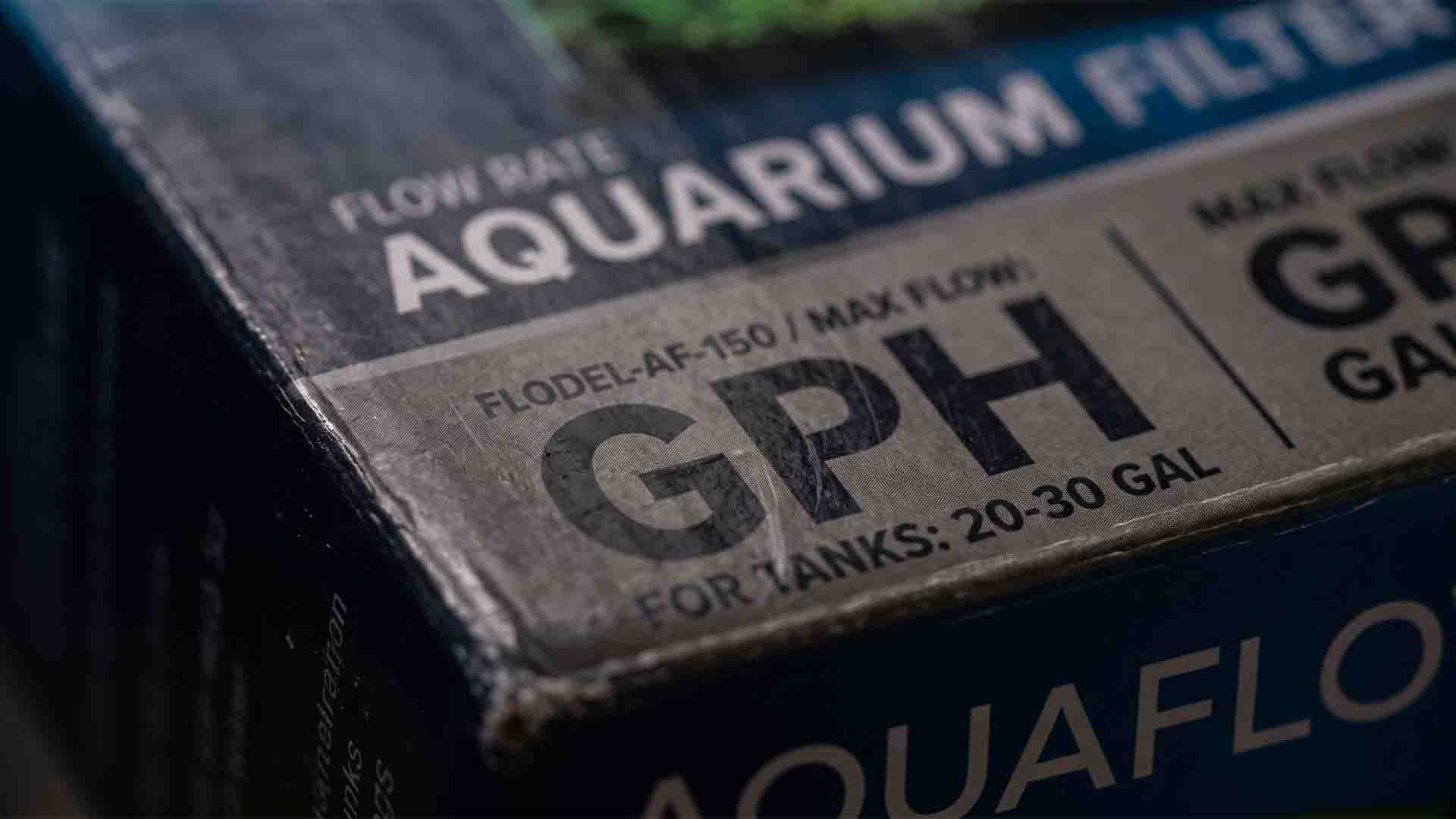
High GPH ratings often mask a severe lack of biological media space, leading to delayed crashes.
The GPH Illusion: Why Motor Speed is a Marketing Trap
The letters “GPH” (Gallons Per Hour) are printed in bold, massive fonts on almost every petco fish filter box. This metric measures exactly how much water the motor can push through the plastic housing in sixty minutes. It sounds impressive. Naturally, as a beginner, you look at the GPH and you pick the strongest motor for your tank size, assuming that faster water equals cleaner water.
This is the GPH Illusion. Motor speed is largely a distraction from what actually keeps fish alive.
Your filter is not a mechanical trash can designed to just trap physical dirt. The motor’s only job is to push the water. The actual filtering—the conversion of deadly fish waste into safe compounds—is done by invisible beneficial bacteria. Those specific bacteria strictly need physical surface area to live on.
When you buy an aquarium filter with a massive motor but a tiny media capacity, you are creating a high-speed sterile environment. The water is rushing through the plastic box so fast, but there is virtually no bacteria inside to actually process the ammonia. It is the equivalent of running a powerful fan in an empty room and expecting it to clean the air.
What to Avoid: The “Sterile vs. Clean” Trap
- Avoid judging a filter by visual clarity alone. Clear water is not a health signal. Toxins like ammonia and nitrite are completely invisible. A filter that polishes the water to a crystal-clear state but holds no biological media is starving your ecosystem.
- Avoid replacing media because it looks “dirty.” The brown sludge inside your filter is not waste; it is biofilm. It is occupied by nitrifying bacteria that convert invisible toxins into something fish can survive. When you clean based on looks, you are not fixing a problem; you are interrupting biology.
- Avoid over-aeration as a fix for poor filtration. Many beginners try to compensate for a weak biological filter by adding massive air stones. However, excessive aeration creates instability. A 2022 study from the Journal of Aquatic Ecology showed tanks with excessive aeration had 40 percent more suspended waste due to unstable gas balance. Your tank doesn’t need a jacuzzi; it needs a steady rhythm.
The Biological Bottleneck Explained
This brings us to the core concept that every successful aquarist eventually learns: The Biological Bottleneck. This is where the standard pet store logic quietly turns against you.
If you have a 20-gallon tank, you need a specific volume of beneficial bacteria to process the waste produced by the fish in that 20 gallons. If your filter only has a piece of sponge the size of a matchbox, it physically cannot hold enough bacteria to support your system. This is a biological bottleneck. The bacteria max out their living space, and any excess ammonia produced by your fish simply remains in the water column.
Small tanks do not fail faster than large tanks; small mistakes just do not dilute. If you are running a heavy bioload but providing a tiny apartment for your bacteria, the system will inevitably choke. This is why beginners experience mysterious deaths. The fish look fine, the water looks fine, but the biological capacity has collapsed.
| The Delayed Crash Timeline | Visual Observation | The Biological Reality |
|---|---|---|
| Day 1 to 10: The Illusion Phase | Water clears up. Fish swim actively. Tank looks pristine. | False stability. Bacteria are slowly trying to attach to surfaces, but the system is incredibly fragile. |
| Week 3: The Subscription Trap | Filter pad looks brown. You throw away the cartridge as instructed. | Nitrogen cycle is literally thrown in the trash. The biological bottleneck tightens. Ammonia begins spiking. |
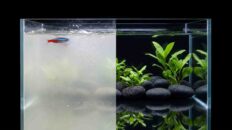
| Week 4: The Bloom | Water turns milky or cloudy white. | Bacterial bloom. Free-floating bacteria are trying to process the sudden ammonia spike. |
| Week 5 to 6: The Silent Reset | Algae takes over. Fish begin gasping at the surface. Mystery deaths occur. | The biological debt has been collected. The system crashes because it lacked permanent media space. |
Scientific Truth: The Danger of Chemical Filtration Addiction
Many standard filters force beginners to rely on activated carbon to keep the water clear. Carbon is highly effective at removing chemical impurities and medications, but it is a terrible host for biology. Its microscopic pores clog and degrade way too fast to ever support a permanent bacterial colony.
Relying on carbon to fix stability issues actually prevents your tank from maturing naturally. A 2021 Osaka University experiment showed that continuous carbon filtration reduced bacterial colonies by nearly 30 percent compared to biological media alone. When you strip the water chemically, you starve the beneficial biofilm that actually processes ammonia. Use carbon smart—for emergencies, not forever. Read the study on freshwater ecosystem stabilization.
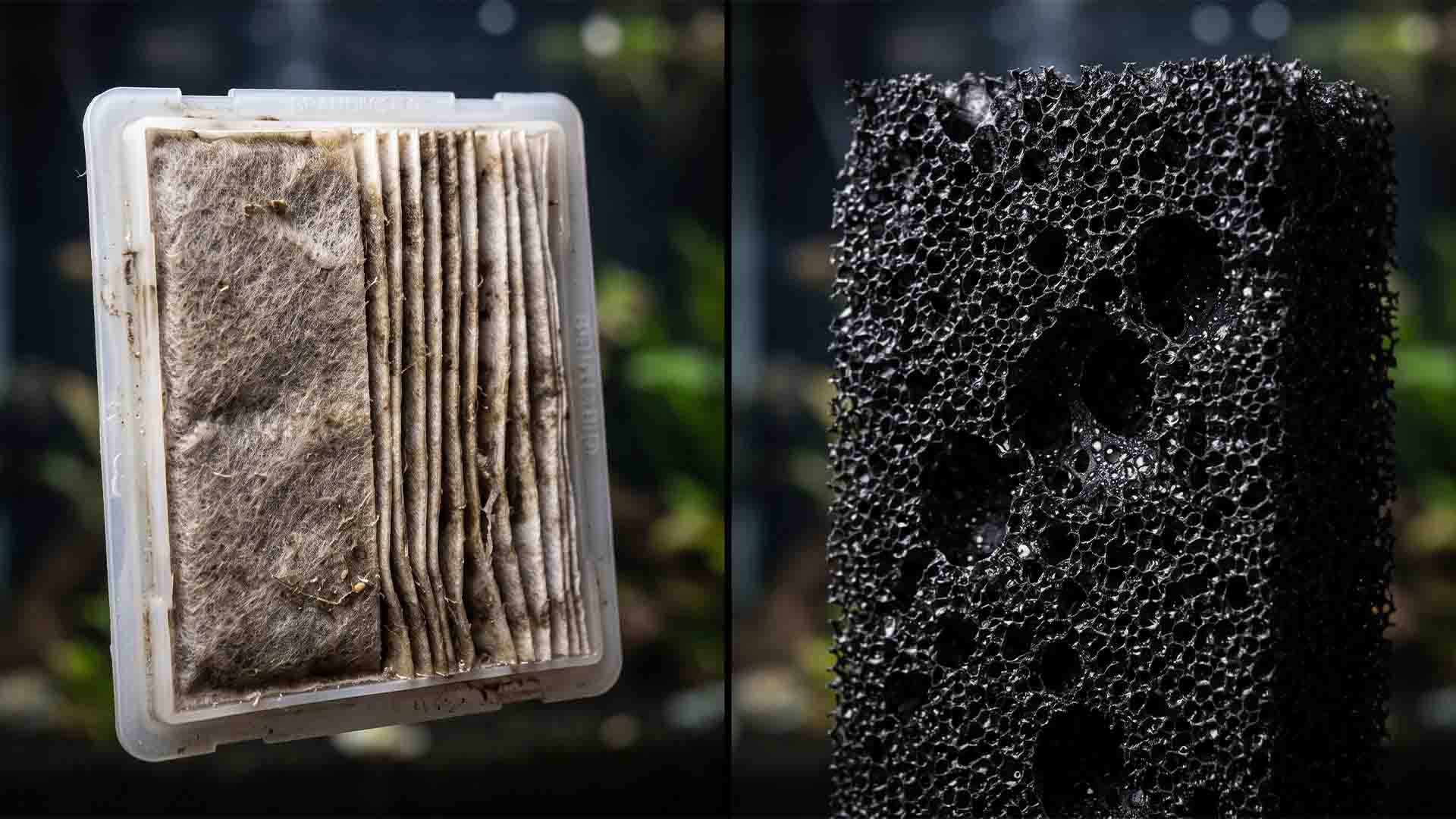
The biological truth: beneficial bacteria require physical surface area to survive and process ammonia, not just high-speed water flow
Fix the Whole System: Stop Over-Fixing
Filtration dynamics dictate how your entire system behaves. If you recently threw away your filter cartridge because it looked dirty, and you are now staring at a tank that looks like a snow globe, do not panic and do not scrub your tank. You are experiencing the consequences of the biological bottleneck.
Most tanks stay cloudy not because they are neglected, but because they are over-managed. Every hand that reaches in too often adds chaos. If you want to know exactly how to guide your tank through this vulnerable recovery phase without losing livestock, you must read our emergency guide on How to Fix Cloudy Aquarium Water FAST. It explains why doing another massive water change right now might actually make the cloudiness worse.
Furthermore, understanding how to clean a filter without destroying it is the most critical skill a beginner can learn. Rinsing your media under tap water kills the cycle instantly. To learn the exact siphon-and-swish method that preserves your biofilm, watch our breakdown: You’re Cleaning Your Filter WRONG! (Stop Killing Your Fish).
Now that we understand the illusions of motor speed and the absolute necessity of biological surface area, we have to look critically at the hardware sitting on the pet store shelf. Not all filters are created equal, and some are mathematically designed to fail you.
The 5 Aquarium Filter Types: A Biological Masterclass
When you stand in front of the filter aisle at PetSmart or PetCo, you are not just choosing a piece of plastic; you are choosing the ecological foundation of your freshwater fish tank system. To prevent delayed biological crashes, we need to look past the marketing labels and analyze the actual physical space available for beneficial bacteria.
Let’s break down the five primary filter types sitting on the shelf today, evaluating them strictly on their biological media capacity, long-term stability, and the hidden maintenance traps they carry.
1. Internal Submersible Filters (The Space Invader)
Internal submersible filters are incredibly common in beginner starter kits. They look sleek, modern, and operate completely underwater, usually tucked into a back corner of the glass. Because the motor is submerged, they are nearly silent. However, mechanically and biologically, they are highly problematic for anything other than a micro-tank.
The Biological Reality: This filter acts as a physical space invader. It takes up valuable swimming room inside your glass, and ironically, it offers the absolute lowest biological media space of all the options. The internal sponge is usually the size of a matchbox. When your fish produce waste, that tiny sponge acts as both the mechanical trap (catching physical dirt) and the biological host (housing bacteria).
Because the sponge is so small, it physically chokes its own flow rate within a week of capturing debris. When the flow slows down, oxygen delivery to the bacteria drops, causing a micro-die-off. This creates a chronic, low-level ammonia presence in the tank that constantly stresses the fish, weakening their immune systems over time.
- Best For: A single Betta fish in a 5-gallon tank where the bioload is incredibly minimal.
- What to Avoid: Never use an internal filter as the primary life support for a 20-gallon community tank. It is a biological disaster waiting to happen.
- Delayed Crash Risk: High. The system constantly chokes itself, leading to unpredictable ammonia spikes when the tiny sponge clogs.
2. Sponge Filters (The Ugly Workhorse)
If you walk into a professional fish breeding facility, you will not see expensive, high-tech plastic boxes. You will see hundreds of sponge filters. You won’t find flashy packaging for these at PetSmart. They are objectively ugly, they sit right in the middle of your aquascape, and they are powered by a vibrating external air pump. But from a biological standpoint, they are invincible.
The Biological Reality: A sponge filter completely ignores mechanical water polishing. It will not suck up large floating debris. Instead, it relies purely on biological superiority. It is essentially one massive block of biological media. As the air pump pushes bubbles up the lift tube, it draws oxygen-rich water gently through the porous foam, bathing billions of beneficial bacteria in exactly what they need to thrive.
There are no proprietary cartridges to buy. There are no impellers to break. It is the safest filter in the building for delicate livestock because it cannot suck up baby shrimp or fry.
- Best For: Breeding tanks, shrimp enclosures, and low-flow setups. They are exceptional for Betta tanks, as Bettas require gentle movement and often suffer from fin exhaustion in high-flow environments.
- What to Avoid: Do not expect a sponge filter to physically clear up a messy tank (like one housing goldfish). It handles invisible toxins (ammonia/nitrite), not physical solid waste.
- Delayed Crash Risk: Zero. Unless you actively boil the sponge in tap water, the biological colony remains incredibly stable.
3. Standard Hang-On-Back (HOB) Filters (The Subscription Trap)
This is the filter almost every beginner buys. The standard Aqueon, Top Fin, or Marina boxes that hang on the back of the tank. The motor pulls water up an intake tube and pushes it through a slide-in filter cartridge (usually a plastic frame covered in white floss and filled with black carbon). It looks efficient, but it is a commercial trap designed to sell you replacements.
The Biological Reality: The internal design is mathematically engineered to force you to buy replaceable carbon pads for the rest of your life. Activated carbon is excellent for removing chemical impurities or leftover medications, but it is a terrible host for biology. Its microscopic pores clog rapidly.
When you follow the box instructions and throw that dirty cartridge in the trash every three to four weeks, you are literally throwing away your nitrogen cycle. You evict the workers that kept the ammonia under control. The tank’s water might look clear the next day, but the invisible toxins are quietly building up. By the time you notice your fish gasping at the surface, the damage is already done.
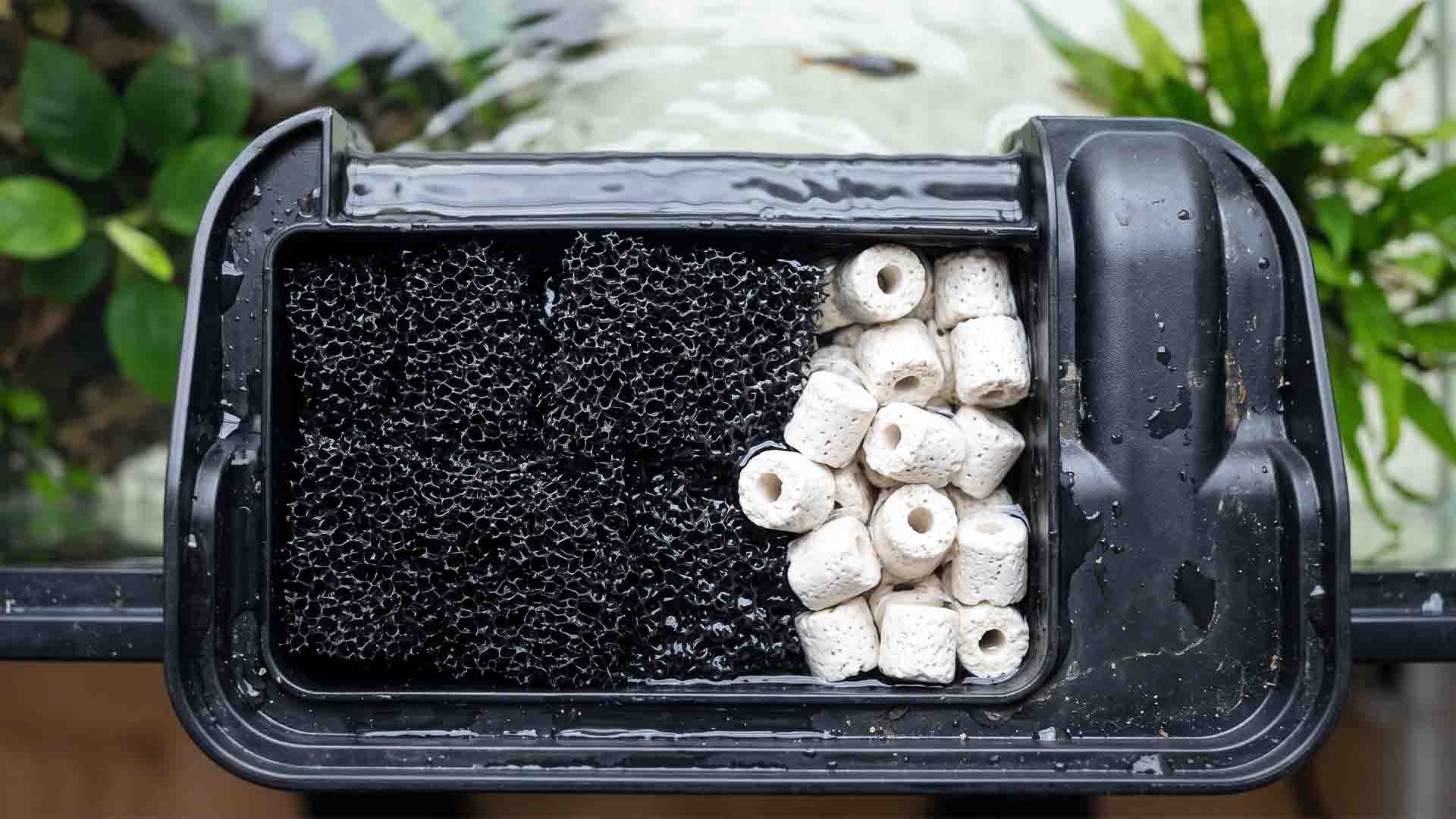
The FTM Hack: Discard the carbon pad on day one and turn a cheap subscription trap into a highly functional biological engine.
Do This Instead: The Aquarium Filter Hack
If you already own one of these standard HOB filters, you do not need to throw it away. You just need to hack it. You buy this filter strictly for the plastic shell and the motor.
- Take the proprietary carbon cartridge and throw it in the trash on day one.
- Go to your local fish store and buy a generic block of coarse aquarium sponge and a small bag of porous ceramic bio-rings.
- Cut the sponge to fit the bottom half of the filter chamber (this will act as your mechanical dirt trapper).
- Pour the ceramic bio-rings on top of the sponge (this is the permanent home for your bacteria).
You never throw these away. When the water flow slows down months later, you simply take the sponge out during a water change and squeeze it gently in a bucket of old tank water. By hacking the box, you turn a cheap subscription trap into a permanent biological engine.
- Best For: Beginners who are willing to ignore the manual, ditch the cartridges, and use custom media.
- What to Avoid: Never rinse your hacked media in municipal tap water. The chlorine will instantly wipe out the bacterial colonies that took weeks to form.
- Delayed Crash Risk: Extreme (if used with cartridges). Replacing the pad guarantees a cycle crash. Hacking the media reduces this risk to near zero.
4. Advanced HOB Filters (The Open Layout)
If you want massive biological media volume without the ugly sponge sitting directly inside your tank, you move to the advanced hang-on-back categories, such as the AquaClear or Seachem Tidal series.
The Biological Reality: This is the open layout. You buy this filter because the manufacturer actually respects the biology of the tank and wants you to build your own media stack. Instead of a narrow slot for a flimsy cartridge, they provide a massive, empty basket. The motor pulls water from the bottom, forces it upwards through a thick mechanical sponge, and then bathes a large upper chamber filled with permanent biological media.
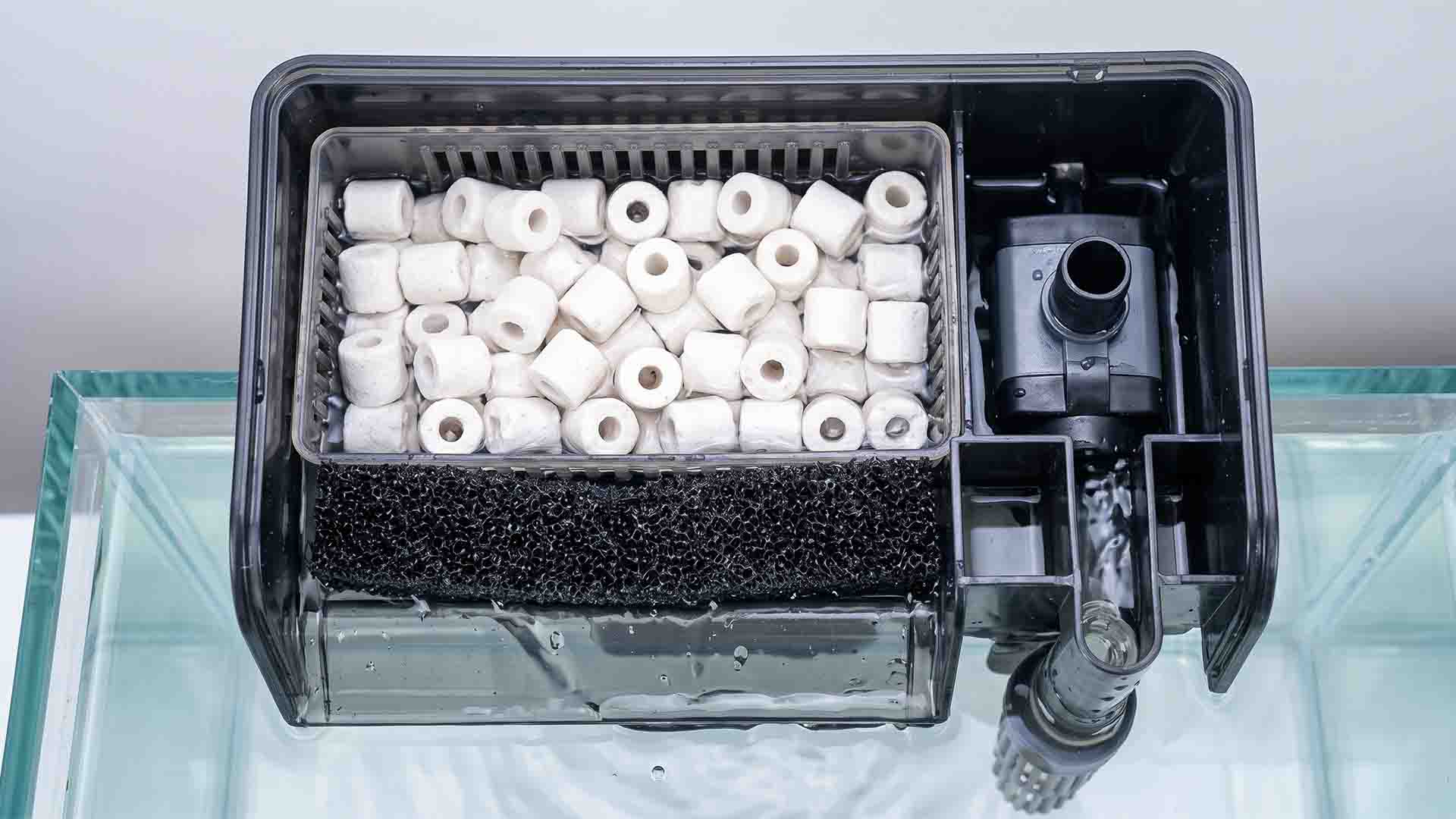
Advanced HOB filters ditch the subscription trap, giving you an open basket to build a permanent biological engine.
This design gives you the biological stability of a large, professional system, while hanging quietly out of sight behind the glass. Because the media capacity is so large, it creates a massive buffer. If you accidentally overfeed your fish, the expansive bacterial colony can quickly multiply and process the sudden spike in ammonia before it harms your livestock.
- Best For: The vast majority of aquarists. For most tanks between 10 and 40 gallons running a school of tetras, livebearers, or a peaceful community, this is the absolute sweet spot.
- What to Avoid: Avoid packing the basket too tightly with fine filter floss. While floss polishes the water to a high shine, it clogs rapidly and can cause the filter to overflow if not monitored.
- Delayed Crash Risk: Low. The large, permanent media bed provides exceptional long-term stability.
5. Canister Filters (The Biological Heavy-Weight)
When you look at the bottom shelf of the pet store, you will see the big, heavy, expensive boxes: Fluval, Marineland, Eheim, and OASE. These are canister filters. They sit entirely outside the aquarium, usually hidden inside the wooden cabinet stand, connected to the tank by two thick hoses (an intake and an output).
The Biological Reality: Canisters are the luxury SUVs of aquarium filtration. They feature huge water volume capacity, massive internal trays for stacking pounds of ceramic bio-media, and powerful motors that keep water crystal clear. If you are keeping messy “monster fish” (like Oscars or Jaguar Cichlids), large African cichlids, or a heavily stocked goldfish tank, a standard hang-on-back will eventually lose the biological race against the sheer volume of waste. You absolutely need the canister.
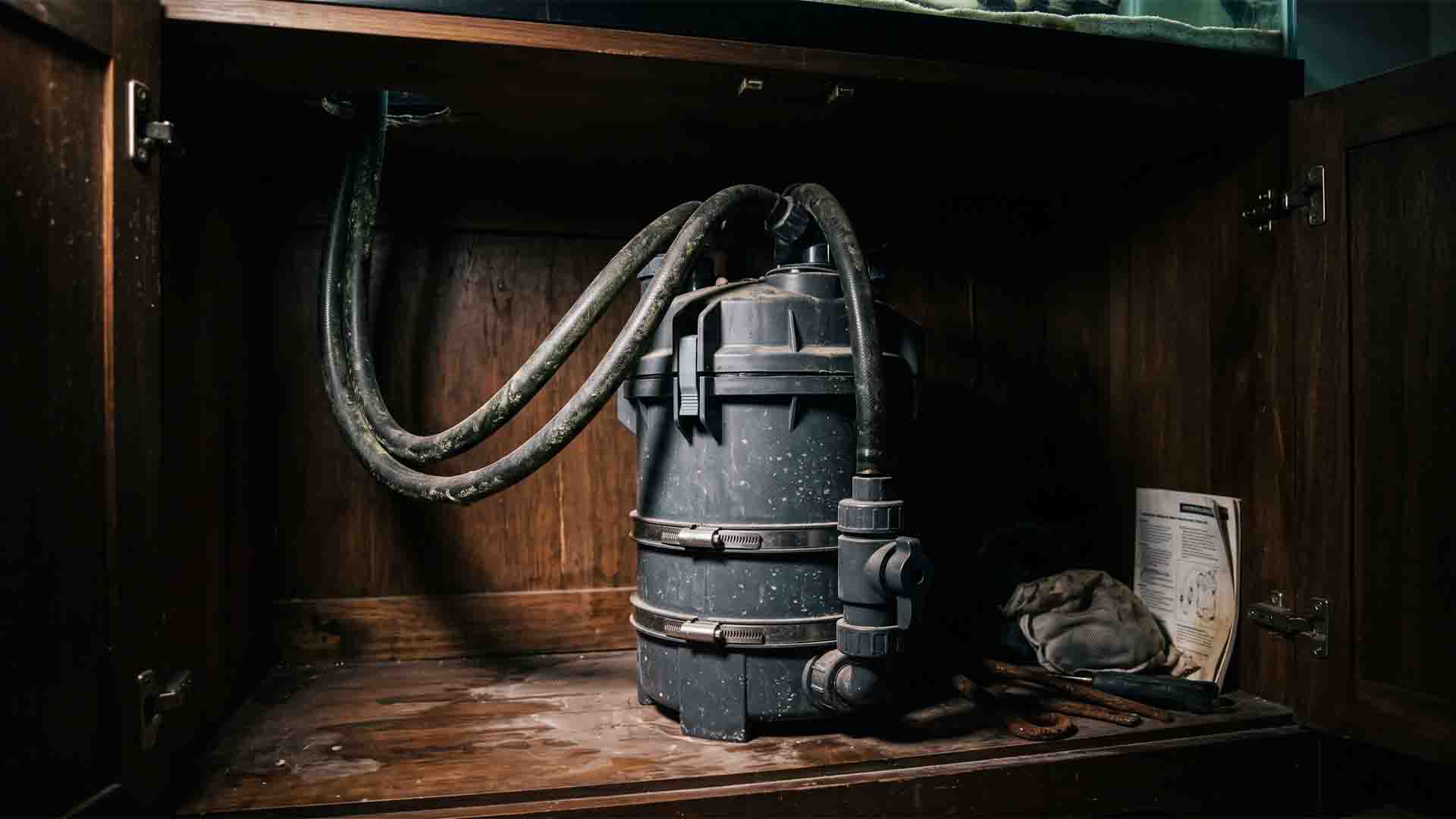
Canister filters offer unmatched capacity, but their hidden nature often turns them into neglected nitrate factories.
However, a canister filter introduces a unique danger: Delayed Responsibility. Because the unit is hidden under the cabinet and operates silently, it is incredibly easy to ignore. The motor is so strong that it will continue pushing water even when the inside is completely packed with decaying physical waste.
When a massive media chamber fills with rotting organic sludge over six months, the filter secretly turns into a nitrate factory. The flow rate might look perfectly fine in the tank, but the trapped waste is constantly degrading your water chemistry. It doesn’t fail quickly. It slowly lowers the pH and elevates nitrates until massive algae blooms take over the tank or the fish succumb to chronic stress.
- Best For: Tanks over 50 gallons, heavy bioloads, predator tanks, and high-tech aquascapes where equipment needs to be hidden from view.
- What to Avoid: Do not install a canister filter if you lack maintenance discipline. The hardware is powerful, but it requires you to manually open the heavy housing every 6 to 8 weeks to rinse the mechanical sponges.
- Delayed Crash Risk: Moderate to High. The crash happens slowly over months of neglect, usually manifesting as uncontrollable algae or sudden disease outbreaks due to poor water quality.
Scientific Truths: The Ecosystem Inside the Plastic
To truly understand why the “clean filter” concept is a myth, we must look at the microbial ecology operating inside these systems. Science tells us that trying to keep an aquarium sterile is the fastest way to destabilize it.
Biofilm is the immune system of your tank.
The brown sludge that coats your filter media, tubes, and sponge is not dirt. It is a highly organized matrix of bacteria, archaea, and microscopic fungi known as biofilm. This biofilm is actively pulling toxic ammonia and nitrite out of the water column. When hobbyists scrub this media under hot tap water until it shines, they are effectively destroying the tank’s immune system. A study published in Microbial Ecology demonstrated that stable, undisturbed biofilm communities significantly increase survival rates in aquatic livestock and prevent sudden pathogenic outbreaks. Read the study.
Flow dynamics dictate bacterial settlement.
Why doesn’t a high GPH (Gallons Per Hour) motor solve everything? Because bacteria need specific conditions to anchor themselves. If the water velocity inside the filter is too extreme, and the media lacks deep, porous micro-cavities (like cheap plastic balls instead of high-grade sintered glass), the bacteria simply wash away. The system becomes a sterile washing machine. Research in Aquacultural Engineering shows that optimized, moderate flow over highly porous ceramic media yields up to 40% more nitrification efficiency than high-speed flow over flat surfaces. Read the study.
Hub & Spoke: Fix the Whole System
Understanding your filter hardware is only the first step. The way you interact with that hardware determines whether your tank lives or dies.
If you recently changed your filter cartridge because it looked dirty, and a few days later your water turned milky white, you are witnessing the biological bottleneck in real-time. That cloudiness is not dust; it is a bacterial bloom panicking to process the ammonia you unleashed when you threw away the old cartridge. To understand exactly how to navigate this dangerous phase without losing fish, you must read our emergency guide on How to Fix Cloudy Aquarium Water FAST.
Furthermore, the physical act of cleaning your filter is where most silent failures begin. Tap water contains chlorine and chloramines specifically designed by city municipalities to kill bacteria. If you rinse your biological media in the sink, you are disinfecting your ecosystem. To learn the exact siphon-and-swish method that preserves your biofilm, review our deep dive: You’re Cleaning Your Filter WRONG! (Stop Killing Your Fish).
Finally, we have to recognize that the filter subscription trap isn’t the only misleading advice given to beginners. The industry routinely pushes instant stocking, chemical fixes, and “miracle” algae eaters that only mask underlying system failures. Protect your budget and your livestock by exposing the 7 Pet Store Lies That Are Costing You Money & Fish.
What to Avoid: The Hidden Behaviors That Sabotage Stable Filters
Most beginners do not fail because they are careless; they fail because they follow advice that optimizes for short-term visual clarity instead of long-term biological survival. Pet stores focus on getting fish home alive today, but biology cares about balance over time. Here are the behavioral traps you must avoid to prevent your aquarium filter from quietly collapsing.
Avoid Chasing Crystal Clear Water (The Illusion Phase)
Why it feels right: Clear water feels safe and looks under control. When the water clears up, confidence replaces patience.
What it silently breaks: Clarity does not mean stability. The period between Day 4 and Day 10 in a new tank is the “Illusion Phase”. The water starts to clear, but the biofilms are still incredibly fragile. If you clean the filter or do a massive water change because the tank looks “ready,” you remove the bacterial colonies that were just about to stabilize the system. Clear water can hide instability, and that false sense of safety is where many new tanks fall apart later.
What to ask instead: “Is my water clear because the biology is mature, or is it clear because I keep changing it?”
Avoid the Carbon Dependency (The Sterile Trap)
Why it feels right: Filter boxes come with carbon cartridges, and using them makes the water sparkle instantly.
What it silently breaks: Carbon is great for removing toxins and medication residues, but constant use strips beneficial compounds that bacteria and plants rely on. A 2021 Osaka University experiment showed continuous carbon filtration reduced bacterial colonies by nearly 30 percent compared to using biological media alone. When you rely on chemical filtration, your biological filter never grows strong enough to handle sudden bioload spikes.
What to ask instead: “Do I have a specific chemical problem to remove, or am I just using carbon out of habit?” Use carbon smart—for emergencies, not forever.
Avoid the “Hurricane Flow” Fix (Over-Aeration)
Why it feels right: If the tank looks dirty or fish look lethargic, turning up the filter flow or adding massive air stones feels like you are “cleaning” the water faster.
What it silently breaks: A 2022 study from the Journal of Aquatic Ecology showed tanks with excessive aeration had 40 percent more suspended waste due to unstable gas balance. Too many bubbles might look nice, but they push CO2 out faster than plants can use it. Furthermore, excessive flow inside the filter housing prevents nitrifying bacteria from anchoring to the media. The system becomes a sterile washing machine.
What to ask instead: “Does my tank need a jacuzzi, or does it just need a steady rhythm?”.
Cause vs. Symptom vs. Real Fix
| Symptom You Notice | What Beginners Do (The Mistake) | The Real Biological Cause | The Permanent FTM Fix |
|---|---|---|---|
| Filter outflow slows down to a trickle. | Replace the entire filter pad or scrub the sponges in hot tap water. | Physical detritus is blocking the mechanical layer, starving the biological layer of oxygen. | Siphon old tank water into a bucket. Gently squeeze the sponge 3-4 times to clear the mud, preserving the biofilm. |
| Tank turns milky white 3 days after cleaning the filter. | Do a 50% water change and add chemical clarifiers. | Bacterial bloom. The nitrogen cycle was damaged, and free-floating bacteria are panicking to process ammonia. | Do nothing. Stop feeding. Add an air stone for oxygen exchange and let the bacteria resettle onto the filter media. |
| Fish gasping at the surface even with the filter running. | Assume the filter motor is too weak and buy a bigger pump. | Ammonia spike has burned the gills, preventing oxygen absorption despite water movement. | Test water immediately. Perform a 30% water change with Prime, and add high-porosity ceramic bio-rings to your filter basket. |
Watch the video above first to see these exact filter types broken down visually, and to understand the biological bottleneck before you spend your money. The video shows the exact behavior shift and ecosystem mechanics this section explains.
Do This Instead: Actionable Steps to Permanent Filter Stability
Most beginners do not fail because they are careless; they fail because the pressure builds quietly until everything breaks at once. That is not a failure; that is delayed feedback. To stop this cycle, you must shift your focus from “cleaning” the filter to “managing” the ecosystem.
- Embrace the Make-or-Break Window: The period from Day 10 to Day 30 is the most critical time for your filter. This is where new tanks choose a path. If you leave the filter mostly alone, the system stabilizes, biofilms mature, and waste processing evens out. If you interfere constantly, you enter a loop of clear water, cloudy water, and mystery deaths. Patience without restraint is still interference.
- Rinse, Don’t Replace: The golden rule of aquarium maintenance. When your flow rate drops, take a bucket of siphoned tank water and gently squeeze your mechanical sponge in it. Never touch your ceramic bio-rings unless they are physically coated in thick sludge, and even then, just swish them lightly. Tap water contains chlorine that can kill all the good bacteria your tank depends on.
- Stack Media Logically: Water must flow through mechanical filtration (sponges) first to trap physical waste, and then flow through biological filtration (ceramic rings/pumice) second. If you reverse this, physical dirt clogs the microscopic pores of your bio-media, suffocating the bacteria.
- Observe Behavior Before Tests: Test kits show the past, but fish behavior shows the future. If you clean your filter and a few days later your fish start hiding behind the filter or breathing harder, the biological capacity has collapsed. Do not wait for an ammonia test to confirm what the fish are already telling you.
Scientific Truths: The Biology Behind the Glass
To truly master aquarium filtration, we must step away from the marketing brochures and look at the microbial reality of what is happening inside that plastic box. Biology does not care about brand names; it cares about stability, surface area, and time.
Biofilm is the immune system of your tank.
Many aquarists look inside their filter, see a brown, slimy layer covering the plastic walls and ceramic rings, and immediately scrub it away. That “dirt” is actually a complex, highly organized matrix called biofilm. It is occupied by autotrophic bacteria that convert invisible, lethal toxins into compounds that fish can survive. A 2018 study in Microbial Ecology found that stable biofilm layers increase shrimp survival and microbial diversity. Removing all biofilm is one of the fastest ways to destabilize a tank. When you deep clean a filter, you are not restoring safety; you are evicting the workers that kept ammonia under control. Read the study.
Every shortcut shifts the biological cost forward.
We live in an era of quick fixes. Bottled bacteria, chemical clarifiers, and replaceable cartridges all work briefly. However, living systems do not survive shortcuts. Biology always collects payment later. When you rush the biological process by replacing filter media instead of letting it mature, the bill arrives weeks later as an ammonia spike or a sudden disease outbreak. The dangerous part is the delay; because when the damage finally shows up, you do not connect it to the shortcut you took three weeks ago. Real clarity is not about cleaning harder; it is about letting biology do its job. Read the study.
Consistency protects fish more than perfection ever will.
The most fragile tanks are often the ones where the owner is constantly chasing perfect water numbers. Constant adjustments stress fish even when the numbers look “better” on paper. A slightly dirty filter with consistent, predictable routines is infinitely safer than a sterile filter that keeps changing. Fish do not need precision; they need predictability. Stable lighting, feeding rhythms, and gentle filter maintenance build biological predictability that limits the chaos algae and pathogens thrive in. Read the study.
People Also Ask (PAA)
- Why do fish die weeks after setting up a new filter?
Because most aquarium problems do not show up immediately; they show up later. The tank may look stable during the “Illusion Phase” (Days 4-10), but if the biological media is inadequate, ammonia builds up silently until the system eventually collapses. - Can I clean my aquarium filter with tap water?
No. Tap water contains chlorine and chloramine which are toxic to the helpful bacteria we need. Always swish your filter sponge in a bucket of old tank water. - How long should I leave a new filter before cleaning it?
You should let your tank stabilize for at least three to four weeks before judging it or attempting to clean the filter media. The less you fix, the faster it fixes itself. - Do sponge filters provide enough oxygen?
Yes. While bubbles themselves don’t add much oxygen, the surface agitation (ripples) created by a sponge filter provides perfect gas exchange and oxygenation for the tank. - Can I run an aquarium without a filter?
Yes, using the Walstad or Father Fish method, where deep organic soil and heavy plant mass act as the filter. However, these systems require intense patience, specific lighting, and a very low fish load.
Filter Maintenance FAQ
Why does my filter outflow keep slowing down?
Your mechanical filtration (the sponge or floss) is doing its job by trapping physical detritus. When the flow slows significantly, it is time to gently rinse the sponge in siphoned tank water. Never ignore a slow filter, as reduced water flow starves your beneficial bacteria of oxygen, leading to a micro-die-off and chronic low-level ammonia.
Should I use activated carbon in my beginner tank?
Usually, no. Carbon is excellent for removing medication residues or chemical impurities, but constant use strips beneficial compounds that bacteria and plants rely on. For everyday filtration, replace the carbon with permanent ceramic bio-rings to build a stronger biological engine.
What is the “1-inch per gallon” rule, and does it affect my filter?
The 1-inch per gallon rule is a dangerous myth that ignores biological load. A 10-inch Oscar produces exponentially more waste than ten 1-inch Neon Tetras. Stocking your tank based on length instead of bioload will rapidly overwhelm your filter’s biological capacity, leading to a delayed system crash.
My water is crystal clear; does that mean my filter is cycled?
Absolutely not. Clear water is not a health signal. Toxins like ammonia and nitrite are completely invisible. Some of the most unstable tanks look perfect right before they fail. You must test the water to confirm the presence of nitrates, which proves the biological cycle is actively processing waste.
Fix the Whole System: Beyond the Filter (Hub & Spoke)
Your filter is the heart of the aquarium, but it does not operate in a vacuum. Most tanks are not ruined by a broken filter; they are ruined by the wrong cleaning response. If you have recently scrubbed your filter and are now dealing with milky water or strange fish behavior, you need to look at the entire system.
First, if your water has turned foggy after a filter change, do not add clarifiers. You are experiencing a bacterial bloom. To understand the exact timeline of this recovery and why a massive water change right now will only make it worse, follow our emergency guide: How to Fix Cloudy Aquarium Water FAST (Don’t Wait). It explains why clarity is achieved by trust, not control.
Next, you must unlearn the physical habits that caused the crash. Rinsing media under the tap is just one error. We break down the exact siphon-and-swish technique that preserves biofilm in our masterclass, You’re Cleaning Your Filter WRONG! (Stop Killing Your Fish). Remember, stability is built after success, not before.
If you are frustrated that your filter isn’t preventing algae, you might be tempted to buy “cleanup crew” fish to solve the problem. But adding animals increases bioload; it doesn’t reduce pressure. Before you buy a Pleco that will outgrow your tank, read Stop Buying Cleanup Crew Fish: The Truth About Algae Eaters to learn why algae is a timing problem, not a livestock problem.
Finally, the filter you choose must match the fish you keep. A standard hang-on-back filter will work perfectly for a school of Tetras, but if you buy a juvenile predator, that filter will inevitably choke. Monster fish trigger delayed failures because their size and pressure catch up weeks later. Protect your ecosystem by reviewing the 10 Aquarium MONSTER Fish That DESTROY Tankmates before you bring a heavy bio-load predator home.
Scientific References
Osaka University (2021) — Carbon Filtration Impacts:
Research conducted on freshwater ecosystem stabilization demonstrated that tanks utilizing continuous activated carbon filtration exhibited a nearly 30 percent reduction in beneficial bacterial colonies compared to those relying solely on porous biological media. The study highlights the danger of chemical dependency in establishing the nitrogen cycle. Read the study.
Journal of Aquatic Ecology (2022) — Gas Balance and Aeration:
A study examining flow dynamics and aeration revealed that aquariums subjected to excessive aeration (heavy air stone usage without dense plant mass) experienced 40 percent more suspended waste. The high turbulence disrupted natural settling and destabilized the gas balance, proving that calm, consistent flow is superior for biological filtration. Read the study.
Microbial Ecology (2018) — Biofilm Resiliency:
This peer-reviewed analysis focused on the role of biofilm as an immune system for aquatic micro-environments. Researchers found that undisturbed, mature biofilm layers significantly increased the survival rates of sensitive invertebrates (like shrimp) and improved the overall microbial diversity, buffering the tank against sudden ammonia spikes. Read the study.
Watch Next: Complete Your Filtration Knowledge
If this guide helped you rethink how your aquarium functions, continue your learning journey with our video masterclasses. These visual guides break down the exact behaviors and habits that keep tanks stable long-term.
- You’re Cleaning Your Filter WRONG! (Stop Killing Your Fish)
Watch exactly how to clean your sponges without triggering an ammonia spike or destroying your nitrogen cycle. Watch Video → - How to Fix Cloudy Aquarium Water FAST (Don’t Wait)
If your tank is currently looking like milk, this is the emergency guide you need to safely guide the biology back to clarity without using chemicals. Watch Video → - 7 Pet Store Lies That Are Costing You Money & Fish
Discover the commercial traps (like the cartridge subscription model) designed to keep you spending money while your fish quietly suffer. Watch Video →
Until next time… keep your tanks balanced, your filters hacked, and your curiosity flowing.